Founder's manual · Ancient Greece v2.1
Ancient Greece manual
You found a polis on the Aegean coast. This manual explains every readout on the screen, every building you can raise and what it costs, how the banks fill while you are away, how vessels, residents and renown work, and what it takes to open the next region. It is written to be read from the top or dipped into from the contents.
- Numbers from the shipped game data
- Real-time timers
- Desktop, tablet and phone
01What Ancient Greece isA builder you come back to
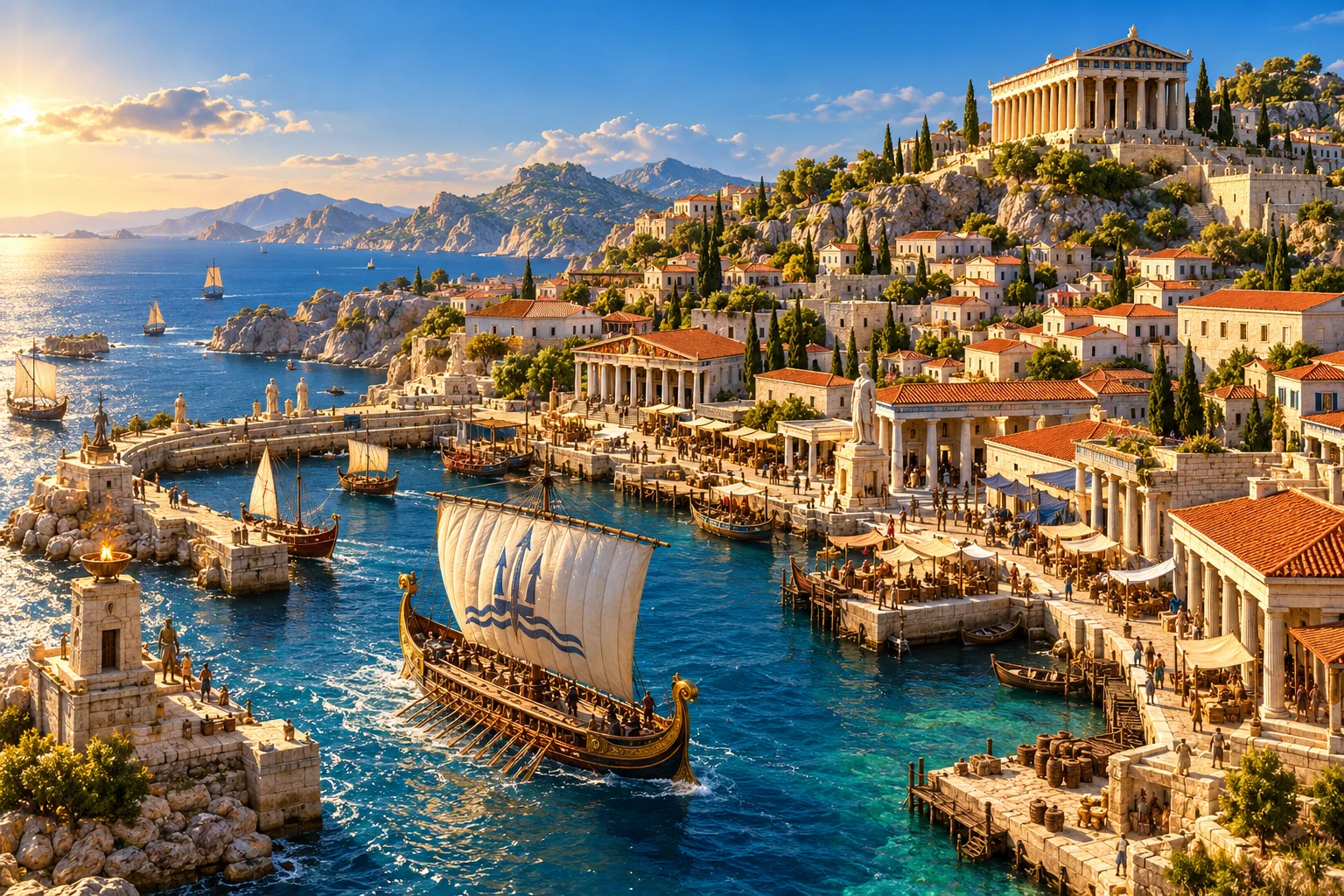
Ancient Greece is a harbour city builder that plays in the browser and keeps running on the clock while the tab is closed. You start around 800 BC with one stone quay and 6,000 drachmae. You end, a few weeks later, with a port the whole Aegean sails through, and then you do it again on another shore.
The game has two halves. The live half is what you watch: merchant vessels tie up at your quays, trade cargo, take on provisions and pay. The come-back half is what happens while you are gone: every building earns drachmae by the minute into its own bank, builds and upgrades finish on real timers, voyages return, rings of unclaimed land get cleared, and the daily reward resets at midnight. Most of your drachmae, by a wide margin, come from the banks. The vessels are the life of the place; the banks are the income.
Nothing is rushed. A tier-1 building takes a minute and a half to open. A tier-4 Great Beacon takes four hours, and taking it to level 3 is a twenty-hour project. There is no speed-up button: the game runs at one pace, Pause or 1×. The only accelerator is Divine Favor, a premium currency you earn steadily by playing and can also buy. Nothing in the game is gated behind it.
What you do, in one breath
- Build next to the polis, inside your plot, and wait for each building to open.
- Tap banks: a glowing coin above a building means it is ready. The drachmae fly to your counter.
- Serve vessels: give them a quay with an open side, provisions, a bed and a hot meal, and they pay and trust you.
- Trade: vessels sell what their home city exports and buy what it imports. Set Buy and Sell per good.
- Keep the water running: every building draws water; wells run dry in a drought, aqueducts do not.
- Grow a town: residents move in when quality of life is high, pay rent and run businesses.
- Expand: clear rings of unclaimed land around the agora; unlock the next of eight regions.
- Sail out: send voyages for charts, cargo, Divine Favor and discoveries for the Chronicle.
- Come back: claim missions and achievements, climb the civic ranks, keep the daily streak.
Two clocks
Two kinds of time run at once and it helps to keep them apart. Real time is the wall clock: build timers, bank filling, voyages, ring clearing and the daily reward all run on it, whether or not the game is open. Game time is counted in days: one game day lasts 48 seconds at 1×, and only advances while the game is open and not paused. Vessels, trade, residents, renown drift and dispatches run on game days. The status bar shows income per game day; the Build panel shows your bank rate per real minute.
02Your first ten minutesMirrors the tour
The game opens a short guided tour the first time you found a polis. This chapter walks the same path, so you can read ahead or catch anything you skipped. You can replay the tour later from Settings.
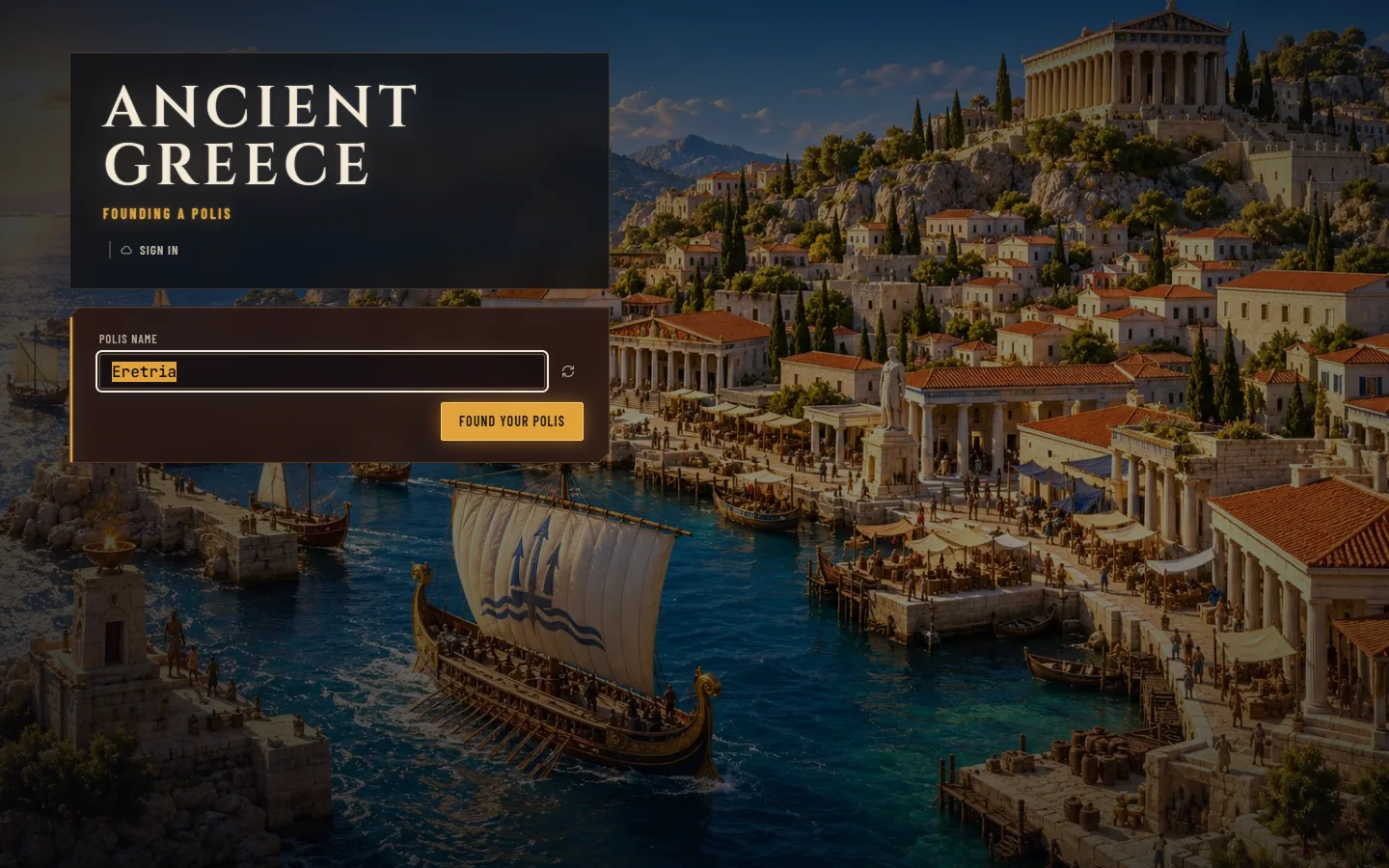
While the building pictures load, the title shows a loading line and Found your polis waits for it to reach 100%. Before the tour starts, two things happen. The daily reward sheet opens, because a fresh profile has a reward waiting; claim it or press Later. And the Build button on the left rail starts to pulse: that is the game's first pointer.
- Welcome, Founder
The Agora sits in the middle of the world. Drag to pan and roll the wheel to zoom; 0 fits the polis back into view. The dashed line around the Agora is the edge of your plot: a 7×5 field of 35 cells you can build on.
- The status bar
Across the top: Drachmae with yesterday's income, Divine Favor with a + that opens the Store, Water used over supplied, Residents over homes with the sailors in port, Renown out of five, then your civic rank ring, the daily reward bell and the Pause / 1× control.
- Open Build
Press B or click Build. The panel lists four tiers of buildings with their cost, bank rate per minute, water pips and build time. Only tier 1 is open at level 1.
- Place a Stone Quay
Click the Stone Quay card, then a bracketed cell. Vessels need a quay, and a quay needs an open side: leave at least one empty cell next to every quay so vessels can pull up. Your first three tier-1 builds are instant.
- Water: a Village Well
Every building draws water; the Agora supplies 10 and a Village Well adds 6. Dig one now, before the readout turns red.
- Storage: a Storehouse
The Agora holds 50 units of cargo. A Storehouse adds 200. Without room you cannot buy what vessels are carrying, and trade is where the live drachmae come from.
- Builds take time from now on
Your fourth building arrives as a scaffold: a hatched frame, a progress ring and a timer. Tier-1 builds take 90 seconds, tier 2 twelve minutes, tier 3 an hour, tier 4 four hours. Click the scaffold and you can skip the wait for Divine Favor: 1 Favor per eight minutes left, so the first skips cost a single Favor.
- Banks
Buildings earn into a local bank. When a bank is a quarter full a bobbing coin appears above the building; when it is full the coin grows a halo and nothing more accrues until you collect. Tap the coin. The Agora's bank is the first one you will see.
- Vessels and trade
The first vessel is already on approach. Fleet (F) shows who is moored, holding or departing and what each merchant house trusts you; Market (M) shows prices, your stock and the Buy / Sell policy for every good.
- Missions and achievements
Missions (J) keeps three goals live at a time and a second tab of lifetime achievements in bronze, silver and gold. Finishing a goal is not the end of it: come back and press Claim.
- Territory and the Greek world
The hatched, dim field around your plot is unclaimed land. Click it to buy the next ring. Map (G) shows the other seven regions, each with its own coast, bias and lock.
- Voyages
Voyages (E) sends a vessel from your Stone Quay to any region, locked or not. It comes back after 30 minutes to a day with goods, often a chart, sometimes Divine Favor or a discovery for the Chronicle.
- Daily reward, the Store and this manual
The bell in the status bar is the seven-day streak. The Store offers Divine Favor through a secure checkout. The city is yours.
A sensible first session
The Founding chapter of missions is the tutorial's reward track: build a quay, a storehouse and a well, tap a bank, serve three vessels, read a dispatch, clear your first ring. Together those seven missions pay 35 Divine Favor on top of the 20 you start with, plus 4,100 drachmae. With a Chandlery and a Harbour Inn down as well, you have a polis that earns about 25 drachmae a minute into its banks and takes visitors' money on the side.
Then leave it. Come back in an hour and the banks are a third full; come back tomorrow and they are at their caps, the ring is cleared and the daily is waiting. That is the shape of the whole game.
03The city viewStatus bar · rail · panels · context bar
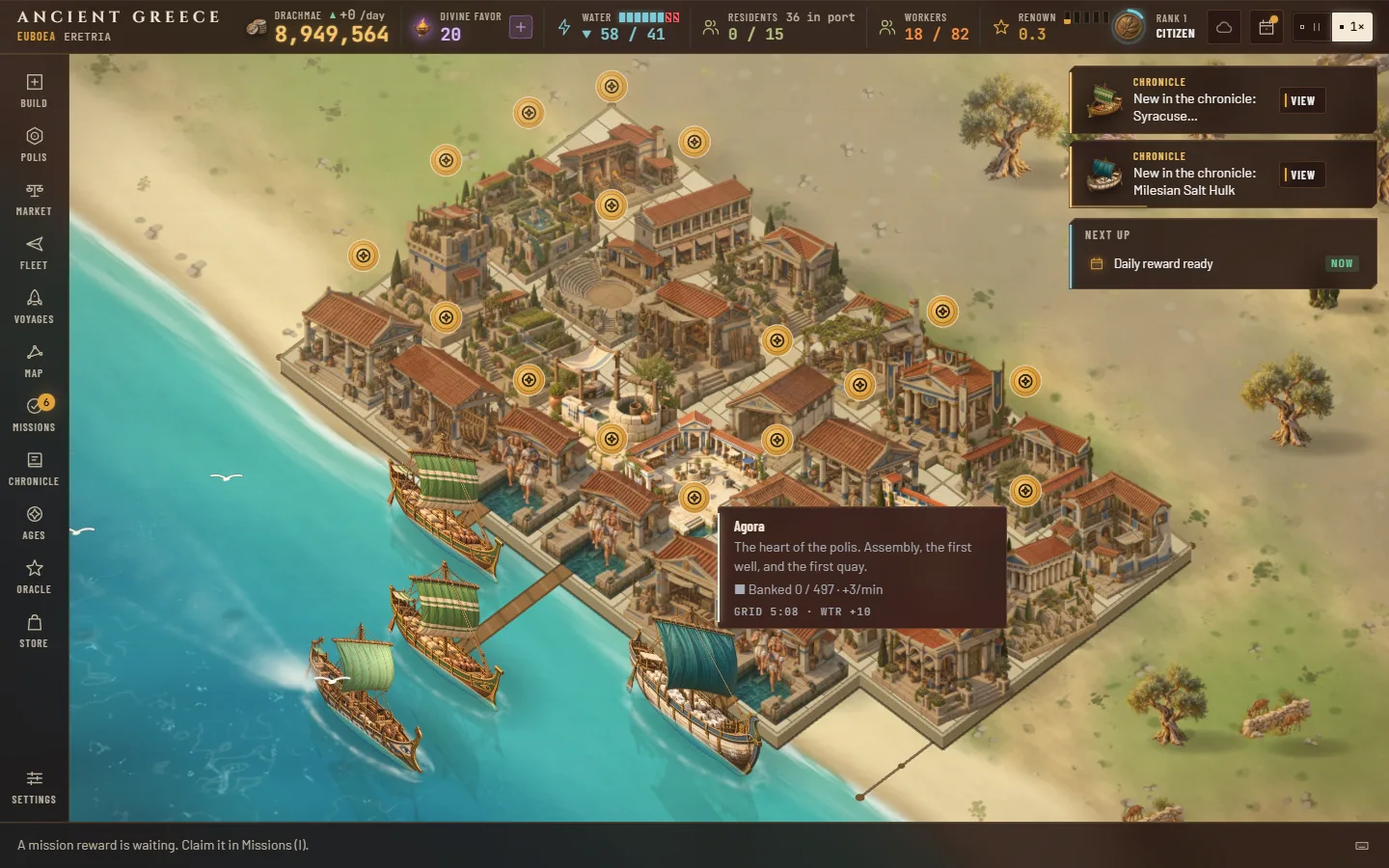
The world fills the screen. Everything you touch floats over it: a status bar, a command rail, one panel at a time, a notices column and a context bar. Nothing blocks the world; the camera slides over when a panel would cover the polis.
The status bar
- Wordmark and region. The active region's name, then your polis name and its register number (AG- and four digits, derived from the name). Click it to open the world map.
- Drachmae. Your purse, shared across every region. The small triangle and figure beside it is yesterday's net income per game day: green up, red down.
- Divine Favor. The premium figure, with a + lozenge that opens the Store.
- Water. Used over supplied, with pips. Blue when healthy, amber with a square during a drought, red with a down-triangle when you are drawing more than you supply.
- Residents. Permanent residents over homes, and under it the visitors in port: the sailors of every moored vessel.
- Renown. Zero to five, with five pips that fill as it climbs.
- Rank ring. Your rank badge inside an arc that fills toward the next rank. Hover it for the exact XP and what the next rank grants.
- Cloud glyph. The state of your cloud save: blue when synced, pulsing while it syncs, amber when offline or in error. Click it for Settings > Account.
- Daily bell. A dot means today's reward is unclaimed.
- Speed. Pause or 1×. There is no faster setting.
Under the bar, a condition strip appears when something is wrong or special: a pirate raid or harbour fever (red), a drought with the days left, or a festival with its spending multiplier.
The command rail
Ten buttons down the left, each with a key: Build B, Polis S, Market M, Fleet F, Voyages E, Map G, Missions J, Chronicle R, Store, and Settings pinned at the bottom. A key pressed twice closes the panel again. Badges on the rail tell you what is waiting: a count on Missions for claimable missions and achievements, a count on Voyages for returned sailors, a count on Polis for ready banks once you can collect them all at once, and a dot on the Store when an offer is on.
Panels
One panel opens at a time, 440 pixels wide, sliding in from the rail. Each has a title, a one-line subtitle with the numbers that matter, sometimes a tab strip, and a scrolling body. The panels in brief:
- Build: four tier shelves of building cards; polis rate, water and quays at the top.
- Polis: with nothing selected, the overview: quality of life, residents, water, quays, the banked total with Collect all, the Territory block, income by category and harbour records. Click a building and the panel becomes its card: bank, build progress, upgrade and demolish.
- Market: every good with its price, your stock, Buy / Sell toggles and a broker button.
- Fleet: vessels in the region by state, then each merchant house's trust bar, office, loan and the goods it brings and buys.
- Voyages: slots, sailors under way with countdown rings, returned sailors with Debrief, and the eight destinations.
- Map: the Greek world as a chart; click a node for its region card.
- Missions with an Achievements tab.
- Chronicle: vessels, peoples and antiquities, dark until found.
- Store and Settings.
Notices and Next up
Toasts stack at the top right, four at most, each with a chip for its kind and often a button: Focus on a finished build, Claim on a completed mission, Debrief on a returned voyage. Below them the Next up strip lists the three soonest timers across builds, upgrades, voyages, ring clearings and the daily reward, counting down live. Click a row to jump to the building or open the panel.
The context bar
The bottom bar is the game talking to you. On the left, a hint that changes with the situation: what to do with a placing ghost, why a cell is invalid, that a quay is blocked, that a coffer is ready, that a voyage is back. In the middle, when a building is selected, its quick actions: Collect, Skip for Divine Favor while it builds, Upgrade, Focus, Demolish. On the right, the ? button opens the keys reference.
In the world
The polis is built on one stone platform laid out as a diamond grid in the same raised three-quarter view as the art, so every building lines up with its neighbours. Each building is a miniature of its picture standing on its cell, with a thin line in its family hue around the cell to keep the grid legible, and neighbouring buildings are joined by covered walkways. Vessels sail the same two diagonals, bow first, and lie broadside to their quay at the end of a gangplank. Hover a building for a tooltip with its description, bank and water; hover a vessel for its merchant house, captain, sailors, hold and wants. Click a building to select it; double-click to focus the camera on it.
A moored vessel lies broadside to its quay at the end of a gangplank, and two to five figures walk across: sailors from merchantmen and hulks, passengers from great galleys, traders from Cyrene and Naucratis vessels, a hoplite when you have a Hoplite Post, porters with a handcart when cargo moves at a storehouse. Vessels waiting for a quay hold off the far corners of the harbour with a HOLD tag and the days waited. The figures need the effects tier at High and a zoom above 0.9, and stay home under reduced motion.
04Building24 buildings · four tiers · three levels
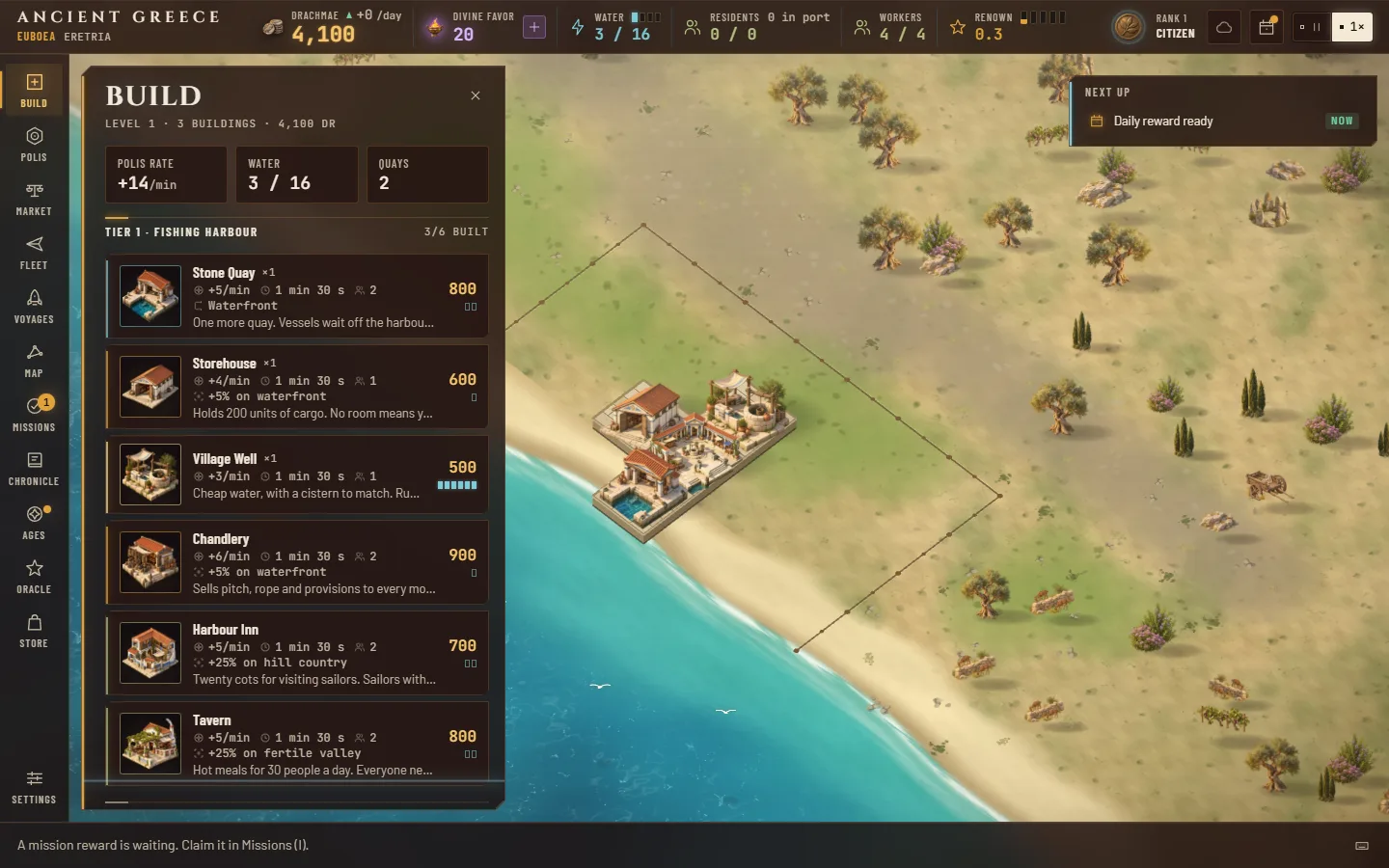
Tier 1: the fishing harbour kit
Six buildings are open from the first minute. Together they are a quay, a hold, water, provisions, beds and meals: everything a passing merchantman asks for.
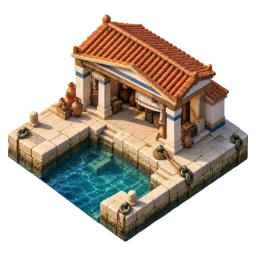 Stone Quay800 dr · 90 s
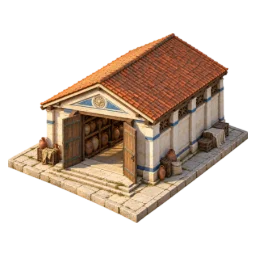 Storehouse600 dr · 90 s
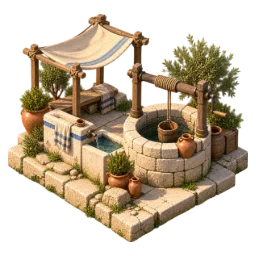 Village Well500 dr · 90 s
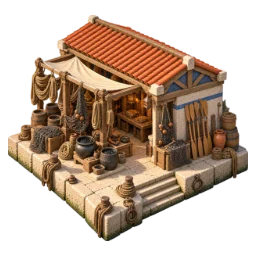 Chandlery900 dr · 90 s
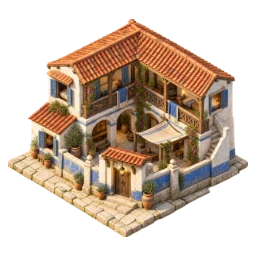 Harbour Inn700 dr · 90 s
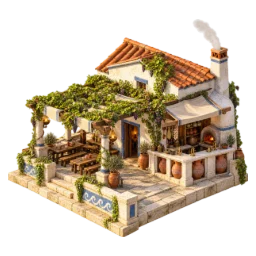 Tavern800 dr · 90 s
Placement rules
Pick a card, then click a cell. A cell is valid when all of these hold, and the hint tells you which one failed:
- It is empty.
- It is inside your plot. Unclaimed land is hatched; clear the ring first (Territory).
- The building's tier is open: tier 2 needs polis level 2, tier 3 level 3, tier 4 level 4.
- You can afford it. Cards you cannot afford dim their cost and show how much more you need.
- It touches the polis: at least one of its four neighbours is already occupied. A building still under construction counts as a neighbour.
The placing ghost is the building's own picture at half strength: clear on a valid cell, hatched red on an invalid one. Placing deducts the cost at once. Press Esc or right-click to stop placing; running out of drachmae stops it for you. The first three tier-1 builds of a brand-new profile finish instantly; every build after that runs on its timer.
Quays and the open side
A Stone Quay only works if it has an empty cell next to it. Vessels pull up to the empty neighbour farthest from the Agora; that cell is the mooring. Box a quay in on all four sides and it still counts as a building, still draws water and still fills its bank, but no vessel can use it. The tooltip and the Polis panel say Quay blocked when this happens, and the context bar nags you about it. The Agora has a quay of its own under the same rule.
Timers, scaffolds and skips
A building under construction is a scaffold: its miniature dimmed and greyed under a hatched frame, with a progress ring and a timer. While it builds it draws water and counts as a neighbour, but it has no quay, beds, storage or bank, and it does not count toward your polis level. When the ring closes the building opens with a chime, a toast offers Focus, and the level is recomputed.
Click a scaffold (or select it and use the context bar) to skip the rest for Divine Favor. The cost is the same everywhere a timer runs: 1 Favor for every 8 minutes remaining, rounded up, minimum 1. Ninety seconds costs 1 Favor; twelve minutes, 2; an hour, 8; four hours, 30; a twenty-hour level-3 beacon, 150.
| Tier | Build | To level 2 (2×) | To level 3 (5×) | Far regions (×1.5) |
|---|---|---|---|---|
| Tier 1 · Fishing Harbour | 90 s | 3 min | 7 min 30 s | 2 min 15 s · 4 min 30 s · 11 min 15 s |
| Tier 2 · Trading Port | 12 min | 24 min | 1 h | 18 min · 36 min · 1 h 30 min |
| Tier 3 · Walled Town | 1 h | 2 h | 5 h | 1 h 30 min · 3 h · 7 h 30 min |
| Tier 4 · Sea Power | 4 h | 8 h | 20 h | 6 h · 12 h · 30 h |
Far regions are the last four in unlock order: the Cyclades, Cyrene, Sicily and the Nile Delta. Their builds, upgrades and ring clearings all take half again as long.
Upgrades
Every building except the Agora has three levels. Select it and press Upgrade. Level 2 costs twice the building's price and takes twice its build time; level 3 costs five times the price and takes five times the build time. The building keeps working at its current level while the scaffold runs, and the upgrade can be skipped like any build. Each level raises the bank rate and cap, and some buildings gain more:
- Stone Quay: vessels are served in 85% of the time at level 2 and 70% at level 3.
- Harbour Inn and Courtyard Houses: 25% more beds or homes at level 2, 50% more at level 3.
- Village Well (lined into a larger cistern) and Aqueduct: 25% more water at level 2, 50% more at level 3.
Upgrades also count toward your polis level, at half a building per level gained.
Demolishing
Select a building and press Demolish. You get half the cost back, and anything in its bank is lost; the confirm says how much. You cannot demolish the Agora, a quay with a vessel at it, or any building whose removal would cut other buildings off from the Agora.
The roster
Rates are drachmae per real minute at level 1; caps are the level-1 bank ceiling, three hours of rate. Water is per building: positive supplies, negative draws.
| Building | Cost | Water | Rate | Cap | L1 Build | Upgrades | What it does |
|---|---|---|---|---|---|---|---|
| Core | |||||||
| Agora | — | +10 | 3 | 540 | — | — | Assembly, one quay, 50 cargo, 6 beds, food for 10. Cannot be upgraded or removed. |
| Tier 1 · Fishing Harbour · 90 s | |||||||
| Stone Quay | 800 | −2 | 5 | 900 | 90 s | L2 1,600 · 3 min L3 4,000 · 7 min 30 s | One more quay. Needs an open side. Upgrades serve vessels 15% / 30% faster. |
| Storehouse | 600 | −1 | 4 | 720 | 90 s | L2 1,200 · 3 min L3 3,000 · 7 min 30 s | Holds 200 units of cargo. |
| Village Well | 500 | +6 | 3 | 540 | 90 s | L2 1,000 · 3 min L3 2,500 · 7 min 30 s | Cheap water; dry during a drought. Upgrades add 25% / 50%. |
| Chandlery | 900 | −1 | 6 | 1,080 | 90 s | L2 1,800 · 3 min L3 4,500 · 7 min 30 s | Sells provisions to every moored vessel; a second chandlery adds 30%. |
| Harbour Inn | 700 | −2 | 5 | 900 | 90 s | L2 1,400 · 3 min L3 3,500 · 7 min 30 s | 20 cots for visiting sailors (25 / 30 upgraded). |
| Tavern | 800 | −2 | 5 | 900 | 90 s | L2 1,600 · 3 min L3 4,000 · 7 min 30 s | Hot meals for 30 people a day. |
| Tier 2 · Trading Port · 12 min · needs polis level 2 | |||||||
| Heralds' Hall | 2,200 | −2 | 15 | 2,700 | 12 min | L2 4,400 · 24 min L3 11,000 · 1 h | More vessels find you (+0.15 traffic each). A second voyage slot. |
| Emporion | 1,500 | −2 | 10 | 1,800 | 12 min | L2 3,000 · 24 min L3 7,500 · 1 h | +5 points of trade margin each; Buy / Sell policies per good. |
| Theatre | 1,200 | −3 | 8 | 1,440 | 12 min | L2 2,400 · 24 min L3 6,000 · 1 h | An entertainment venue: sailors spend more and rate you higher. |
| Terrace Gardens | 1,300 | −3 | 9 | 1,620 | 12 min | L2 2,600 · 24 min L3 6,500 · 1 h | Feeds 40 and grows 4 grain a day into stock. |
| Asklepion | 1,400 | −2 | 9 | 1,620 | 12 min | L2 2,800 · 24 min L3 7,000 · 1 h | Full health care; contains harbour fever. |
| Courtyard Houses | 2,000 | −3 | 13 | 2,340 | 12 min | L2 4,000 · 24 min L3 10,000 · 1 h | Homes for 15 residents (19 / 23 upgraded, rounded in the total). |
| Aqueduct | 3,000 | +25 | 20 | 3,600 | 12 min | L2 6,000 · 24 min L3 15,000 · 1 h | Big water supply, immune to droughts. Upgrades add 25% / 50%. |
| Customs House | 2,000 | −1 | 13 | 2,340 | 12 min | L2 4,000 · 24 min L3 10,000 · 1 h | 1.5 drachmae of tariff on every unit traded, per house. Catches smugglers. |
| Hoplite Post | 1,800 | −2 | 12 | 2,160 | 12 min | L2 3,600 · 24 min L3 9,000 · 1 h | Cuts raid losses; two posts stop raids outright. |
| Tier 3 · Walled Town · 1 h · needs polis level 3 | |||||||
| Academy | 2,500 | −2 | 17 | 3,060 | 1 h | L2 5,000 · 2 h L3 12,500 · 5 h | Resident growth doubles. |
| Trapeza Bank | 4,000 | −2 | 27 | 4,860 | 1 h | L2 8,000 · 2 h L3 20,000 · 5 h | Lend to the merchant houses at interest. |
| Stoa | 3,500 | −3 | 23 | 4,140 | 1 h | L2 7,000 · 2 h L3 17,500 · 5 h | A venue; every resident earns 3 drachmae of business a day (doubled in a festival). |
| Animal Garden | 2,800 | −4 | 19 | 3,420 | 1 h | L2 5,600 · 2 h L3 14,000 · 5 h | A venue; exotic animals in stock (up to 30 per garden) draw paying visitors. |
| Bronze Foundry | 3,200 | −6 | 21 | 3,780 | 1 h | L2 6,400 · 2 h L3 16,000 · 5 h | Turns 6 copper ore into 3 bronze ingots every game day. |
| Shipyard | 5,000 | −5 | 33 | 5,940 | 1 h | L2 10,000 · 2 h L3 25,000 · 5 h | Repair fees; +3 trust per vessel instead of +2. A third voyage slot. |
| Tier 4 · Sea Power · 4 h · needs polis level 4 | |||||||
| Hilltop Temple | 4,500 | −2 | 30 | 5,400 | 4 h | L2 9,000 · 8 h L3 22,500 · 20 h | +0.5 to the renown target each (up to +1.0). |
| Great Beacon | 12,000 | −15 | 80 | 14,400 | 4 h | L2 24,000 · 8 h L3 60,000 · 20 h | Calls the Naucratis great galleys; traffic ×1.25 (doubled again in the Nile Delta). |
Level-2 and level-3 bank rates are 1.6× and 2.4× the level-1 rate, with caps of 4 and 6 hours of the new rate: a Stone Quay goes 5 → 8 → 12 drachmae a minute with caps of 900 → 1,920 → 4,320. In far regions multiply every time in this table by 1.5.
05Banks and incomeCoffers · caps · offline accrual
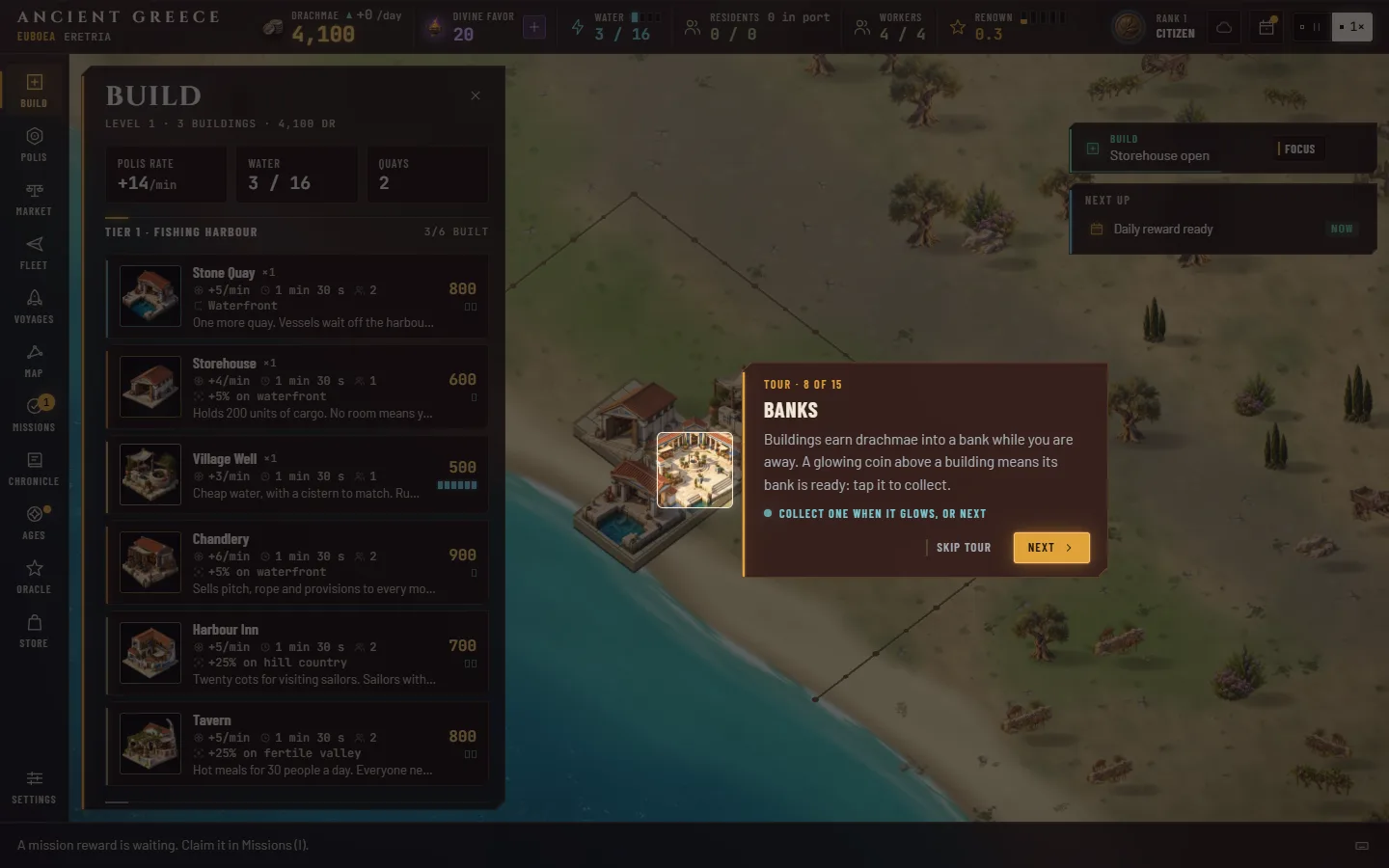
Every building with a rate earns drachmae per real minute into its own bank, which the game also calls a coffer. Banks fill whether or not the game is open, up to a cap. Tapping them is the single most satisfying act in the game, and it is where most of your money comes from.
Rates and caps
At level 1 a building's rate is its cost divided by 150 per minute, rounded: a Stone Quay earns 5, an Aqueduct 20, a Great Beacon 80. The Agora earns 3. Its cap is 180 minutes of rate, so three hours after you last collected, the bank is full and stops. Level 2 multiplies the rate by 1.6 and raises the cap to 240 minutes of the new rate; level 3 multiplies the level-1 rate by 2.4 with a cap of 360 minutes.
A building under construction banks nothing; a building upgrading keeps banking at its old level until the scaffold closes. Civic rank 5, Strategos, adds 5% to every rate and cap.
Collecting
At a quarter full a coin appears above the miniature and the building counts as ready. At the cap the coin grows and gains a halo: full, nothing more accrues. Click the coin, or select the building and press Collect. The whole-drachma part of the bank flies to your counter, and you earn 1 rank XP for every 100 drachmae collected (fractions carry over).
Shift-click any cell to collect every ready bank within three cells of it. From civic rank 3, Harbourmaster, the Polis panel's Collect all button and the Collect all on the while-you-were-away sheet empty every bank in the polis at once, and the Polis rail button badges the ready count.
While you were away
On every load the game settles what happened since you left, in every region you own:
- Banks accrue for the time you were gone, up to 24 hours per bank and never past the cap.
- Builds, upgrades, ring clearings and voyages finish by the wall clock. Scaffolds you left running are buildings when you return.
- The active region also replays up to two hours of game time in a fast catch-up (150 game days), so vessels moored, prices drifted and dispatches arrived while you were out. Dispatches that need a decision wait for you.
If you were gone a minute or more, a While you were away sheet sums it up: drachmae banked, vessels served, builds finished, voyages back, with a Collect all button once you have the rank for it. Shorter gaps settle silently.
While you play, the regions you are not looking at keep banking too, refreshed every five seconds, so a trip to another polis never costs the one you left.
The daily ledger
Income per game day, shown beside Drachmae in the status bar and broken down in the Polis panel, is the live half: mooring and services, cargo bought and sold, tariffs, resident rent, Stoa business, sailors' spending, Animal Garden tickets, office leases and loan repayments, less upkeep. Upkeep is 0.4% of every building's cost plus one drachma per resident, per game day, scaled like the rest. Bank collections appear in the breakdown as banks on the day you collect.
06Vessels, merchant houses and tradeSeven houses · four hulls · twelve goods
Vessels are the live half of the polis. They arrive from the edge of the region, take a quay, pay their fees, sell what their home city exports, buy what it imports, stay a while and leave. Every visit nudges how much their merchant house trusts you.
Arrivals
How often vessels appear depends on you. The base rate is 0.9 per game day, plus 0.6 for every star of renown, plus 4 times your traffic bonus (each Heralds' Hall adds 0.15, so 0.6 per hall), plus 0.4 per house office and 0.5 per active contract. A Great Beacon multiplies the whole thing by 1.25, and by 2.5 in the Nile Delta. During a weekly Convoy window traffic is ×1.5. At most 16 vessels are in the region at once.
Which merchant house sends the vessel is weighted by trust (1 + trust / 50) and by the region's bias toward its home fleets. The Naucratis Grand Fleet only appears once you have a Great Beacon.
Quays and the queue
A vessel heads for a free quay: a Stone Quay or the Agora with an empty side. If none is free it holds off the harbour; the Fleet panel shows the days waited. If two vessels are already holding, further arrivals divert elsewhere, which counts against your renown. A vessel that waits three game days gives up: its house loses 6 trust and your renown takes the hit. A vessel that waited more than a day before mooring also costs 2 trust per whole day waited.
What a vessel pays
Everything happens the moment a vessel moors. It pays its mooring fee, buys provisions if you have a Chandlery (60 base, scaled by hull size; two chandleries add 30%), and six times in ten pays for repairs if you have a Shipyard (150 base, scaled by hull). All of these are multiplied by your water efficiency and by the live factor of 0.06. A standing contract discounts fees 15%.
Then it trades. For each good in its hold that your policy says Buy, you pay 65% of the effective price (less 5 points per Emporion, which lowers what you pay), limited by storage room and your drachmae. Then it buys what its home city imports, at 105% of the price plus 5 points per Emporion, splitting its hold across the goods you have. Spare hold space it fills on spec with anything else you sell, at 85% plus margin, most valuable first. If you have a Customs House, every unit traded in either direction pays 1.5 drachmae of tariff per house. The vessel then stays for its service time, shortened 15% or 30% by an upgraded quay, and departs.
| Class | Hold (units) | Sailors | Moored for | Mooring fee | Notes |
|---|---|---|---|---|---|
| Light Galley | 30 | 4 | 0.6 days | 150 | Athenian Owl Lines, Tyrian Traders |
| Merchantman | 80 | 10 | 1.0 day | 280 | Every house except Naucratis |
| Round Hulk | 180 | 16 | 1.6 days | 450 | Chalcis, Syracuse, Miletus |
| Great Galley | 120 | 40 + 60 passengers | 2.0 days | 1,000 | Naucratis Grand Fleet only; needs a Great Beacon |
Holds and fees are listed before the 0.06 live factor: in play a Merchantman carries 5 units and pays about 17 drachmae to moor. Sailor counts are not scaled; they are the visitors who eat, sleep and spend.
The merchant houses
Seven trading houses, each with a home city that sets what its vessels bring and what they want. The Fleet panel shows every house's trust out of 100, whether it keeps an office, any loan outstanding, and the goods it brings and buys.
| House | Home city | Hulls | Brings (sells to you) | Buys (takes from you) |
|---|---|---|---|---|
| Chalcis Ore Carriers. Bulk ore hulks. Slow, huge, and always short of provisions. | Chalcis · mining and metal port | Round Hulk, Merchantman | Copper Ore, Raw Silver | Grain, Sea Salt, Medicine |
| Athenian Owl Lines. Fast galleys moving fine wares and medicine around the Aegean. | Athens · workshop city | Light Galley, Merchantman | Fine Wares, Bronze Ingots | Copper Ore, Grain, Frankincense, Livestock |
| House of Battos. Specialists in live cargo. Their holds smell like a Libyan stable. | Cyrene · libyan coast colony | Merchantman | Exotic Animals, Medicine, Figs and Grapes | Fine Wares, Bronze Ingots |
| Syracuse Grain Guild. Farmer-owned guild carrying grain and fruit to the colonies. | Syracuse · grain-rich colony | Merchantman, Round Hulk | Grain, Figs and Grapes, Livestock | Fine Wares, Medicine, Woven Cloth |
| Tyrian Traders. Frankincense and purple cloth. Old partners who honour every bargain. | Tyre · phoenician island port | Light Galley, Merchantman | Frankincense, Woven Cloth | Sea Salt, Grain, Medicine |
| Miletus Sea Traders. Salt carriers, and the occasional very wet animal crate. | Miletus · ionian sea power | Round Hulk, Merchantman | Sea Salt, Exotic Animals | Fine Wares, Woven Cloth, Grain |
| Naucratis Grand Fleet. Great galleys carrying wealthy passengers and rare goods. Needs a Great Beacon. | Naucratis · nile trading port | Great Galley | Fine Wares, Medicine, Woven Cloth | Exotic Animals, Frankincense, Raw Silver, Figs and Grapes |
Trust, offices and contracts
Every house starts at 40 trust. Each vessel served adds 2, or 3 if you have a Shipyard, less 2 for every whole game day it waited once the wait passed a day. At 75 the house opens a permanent office in the polis: regular traffic (+0.4 to the arrival rate) and an 80-drachma lease per game day, scaled. A Trade Contract dispatch offers ten days of extra vessels from one house for a 15% fee discount; signing it adds 10 trust and two vessels at once. Trust also weights which house shows up next and sets your loan rate.
Loans
With a Trapeza Bank, the Fleet panel gains a Lend button per house. The minimum loan is 500 drachmae and a house carries one at a time. The rate is 25% minus a tenth of the house's trust: 21% at 40 trust, 17.5% at 75, 15% at 100. Principal plus interest is repaid in ten equal daily parts. Each day there is a chance of default equal to (100 − trust) × 0.025%; a default writes off what is left and costs the house 15 trust; a loan repaid in full adds 8. Loans are player money and are never scaled down.
The Market
Twelve goods, each with a base price. Every game day a price drifts up to 6% at random and reverts 8% of the way toward base, staying between half and 1.8 times base. The region's bias multiplies some goods (copper and bronze +40% in Attica, for instance). A Trade Boom triples one good for four days; a Market Glut halves one for four days. The Market panel shows every good with its picture, the current price, your stock, a Buy / Sell toggle and a broker button that sells your whole stock of a good to a passing broker at half price.
| Good | Base | Kind |
|---|---|---|
| Copper Ore | 8 | mineral |
| Bronze Ingots | 30 | mineral |
| Raw Silver | 45 | mineral |
| Sea Salt | 5 | mineral |
| Grain | 6 | crop |
| Figs and Grapes | 14 | crop |
| Frankincense | 40 | crop |
| Livestock | 25 | animal |
| Exotic Animals | 70 | animal |
| Woven Cloth | 18 | made |
| Fine Wares | 55 | made |
| Medicine | 60 | made |
Storage and production
The Agora holds 50 units and each Storehouse 200. Terrace Gardens add 4 grain a day; a Bronze Foundry turns 6 copper ore into 3 bronze ingots a day (half again as much bronze in Thrace). Residents eat 0.15 grain each per day, fruit if the grain runs out. Voyage cargo and daily crates go into the same stock; whatever does not fit is brokered at half price on the spot.
07Water and conditionsWells · aqueducts · droughts · raids · festivals
Water is a budget, not a resource you store. The status bar shows what your buildings draw over what you supply. Stay under it and nothing happens; go over it and everything slows down.
Supplying and drawing
The Agora supplies 10. A Village Well supplies 6 (7.5 at level 2, 9 at level 3, rounded in the total). An Aqueduct supplies 25 (31 and 38 upgraded). Every other building draws between 1 and 6, and the Great Beacon draws 15. A building under construction already draws its water. The Build panel's cards show the draw as pips so you can see the cost before you place.
Shortage
When draw exceeds supply the polis runs at an efficiency of supply divided by draw, never below 30%. Efficiency multiplies mooring fees, provisions and repair income, resident rent, sailors' spending and the quality-of-life score, and a shortage knocks 0.6 off the renown target every day it lasts. The water readout turns red with a down-triangle, the miniatures take on a grey cast, the context bar tells you, and the log reminds you every three days. Dig a Village Well or build an Aqueduct.
Droughts
A Drought dispatch runs every Village Well dry for three game days. Aqueducts are unaffected. The condition strip counts the days down and the water readout goes amber. In Attica droughts come twice as often, which is the region's way of telling you to build an aqueduct early.
Dispatches
Every four to eight game days (the first between days 4 and 7) a dispatch arrives and pauses the simulation until you read it. Most just happen; two ask for a decision. Their weights are shaped by the region, and some only occur once your polis is big enough.
| Dispatch | From level | What happens |
|---|---|---|
| Drought | 1 | Village wells dry for 3 days. Weight 3; doubled in Attica. |
| Trade Boom | 1 | One good's price triples for 4 days. Weight 3. |
| Market Glut | 1 | One good's price halves for 4 days. Weight 2. |
| Pirate Raid | 2 | With two or more Hoplite Posts: driven off, no losses. Otherwise you lose 35% of every stock and up to 8% of your drachmae (at most 1,500), each divided by 1 + posts. Weight 2; doubled in the Cyclades. |
| Harbour Fever | 2 | With an Asklepion: contained. Without: a quarter of your residents leave and renown drops 0.5. Weight 2. |
| Refugee Convoy | 2 | Choice. Take them in with free homes: up to 20 residents settle and renown rises 0.5. Take them in without homes: −0.1. Turn them away: −0.15. Weight 2. |
| Famous Voyager Arrives | 2 | Renown +0.5, or +1.0 with a Hilltop Temple, and 600 drachmae in guest gifts. Weight 1. |
| Trade Contract | 2 | Choice. Sign: ten days of extra vessels from one house at a 15% fee discount, +10 trust, two vessels now. Weight 2. |
| Smugglers Caught | 2 | With a Customs House or Hoplite Post: 5 to 15 units each of frankincense, fine wares, silver and medicine, as storage allows. Without: they slip through. Weight 1. |
| Polis Festival | 3 | Visitor spending and Stoa business doubled for 3 days. Weight 2; doubled in Cyrene. |
Weights are relative draws from the pool of dispatches your level allows. Reading a dispatch counts toward the Incoming Dispatch mission.
Pirates, in detail
One Hoplite Post halves raid losses (35% of stock becomes 17.5%); two posts stop raids entirely. In the Cyclades, where raids are twice as likely, two posts are not optional. A raid also shakes the camera and raises the red condition strip for a few seconds.
08Sailors, residents and quality of lifeFood · beds · venues · health
Two kinds of people are in the polis. Visitors are the sailors of moored vessels: they are counted on the status bar as in port, they need beds and meals, and they spend. Residents are permanent: they need homes, they pay rent, and they only come when the polis feels like a place to live.
Quality of life
The Polis panel shows a ring and four rows. Each row is a coverage from 0 to 100%, and the score is their weighted sum, multiplied by your water efficiency:
- Food (35%): food capacity over everyone in port. The Agora feeds 10, a Tavern 30, Terrace Gardens 40.
- Beds for sailors (20%): visitor beds over visitors. The Agora has 6, a Harbour Inn 20 (25 and 30 upgraded).
- Entertainment (25%): forty people per venue. Venues are the Theatre, the Stoa and the Animal Garden. With nobody in port, one venue counts as full coverage and none as half.
- Health care (20%): 100% with an Asklepion; without one, 70%, falling to 40% once more than 20 people are in port.
The score drives three things: how much visitors spend, whether residents arrive or leave, and 2.4 of the 5 points of your renown target. The Good Harbour mission asks for 70%.
Visitors
Every game day each visitor spends about 6 drachmae times (0.5 + 0.6 food + 0.4 beds + 0.9 fun) times efficiency, doubled during a festival and scaled by the live factor. A well-kept polis with a Theatre earns roughly three times as much from its sailors as a bare one.
Residents
Residents need homes: Courtyard Houses hold 15 (19 and 23 upgraded). Each game day, if there is a free home and the quality-of-life score is above 55%, there is a 70% chance that new residents arrive: at least one, and otherwise 8% of the visitors in port times the score, doubled with an Academy, and multiplied by the region's growth bias (twice in Sicily; none ever settle in Thrace). If the score falls below 35%, 5% of your residents leave every day. Harbour fever without an Asklepion sends a quarter of them away at once.
Residents pay 6 drachmae of rent each per game day, times efficiency, times the region's rent bias (+30% in Sicily), scaled; with a Stoa they add 3 drachmae each of business a day, doubled in a festival. They eat 0.15 grain each per day. Each resident adds a drachma of upkeep.
The status bar's Residents readout shows residents over homes. Having any residents at all adds 0.4 to the renown target, and towns of 10 and 50 are mission goals; the Town Planner achievement counts your peak at one polis.
09Renown and polis tiersFive stars · five levels
Renown is a number from 0 to 5 that drifts toward a target every game day. Polis level is a threshold on building count and renown together. Levels open new building tiers and new regions, and once reached they never fall.
How renown moves
Each game day the target is computed and your renown moves 12% of the way toward it. The target is the sum of:
- 2.4 × the quality-of-life score;
- up to 1.0 for variety: the number of different building kinds you have built, out of 14;
- 0.4 if anyone lives in the polis;
- 0.5 per Hilltop Temple, up to 1.0;
- 0.3 with a Great Beacon;
- minus 0.25 per vessel recently turned away or diverted (fading by a quarter each day), up to 1.2;
- minus 0.8 while you are in debt; minus 0.6 while water is short.
Dispatches move it directly: the voyager adds 0.5 (1.0 with a Hilltop Temple); harbour fever without an Asklepion costs 0.5; refugees add 0.5 or cost 0.1 or 0.15. Renown feeds back into traffic, 0.6 arrivals per day per star.
The five tiers
| Level | Tier | Buildings | Renown | What it opens |
|---|---|---|---|---|
| L1 | Fishing Harbour | 0 | 0.0 | Tier-1 buildings. Euboea. |
| L2 | Trading Port | 6 | 1.0 | Tier-2 buildings. Attica and Thrace become unlockable. Pirate, fever, refugee, voyager, contract and smuggler dispatches begin. |
| L3 | Walled Town | 14 | 2.0 | Tier-3 buildings. Ionia, the Cyclades and Cyrene. Festivals begin. |
| L4 | Sea Power | 24 | 3.0 | Tier-4 buildings. Sicily and the Nile Delta. |
| L5 | Great City | 36 | 4.0 | The end of the road. A title, an achievement tier, and the log's congratulations. |
The building count excludes the Agora and anything still under construction, and adds half a building for every upgrade level above 1. A level is reached when both numbers are met; the polis then celebrates, you earn 100 rank XP, and the Build panel's next shelf unlocks. Region unlocks look at the best level you have reached in any region.
10TerritoryRings of unclaimed land
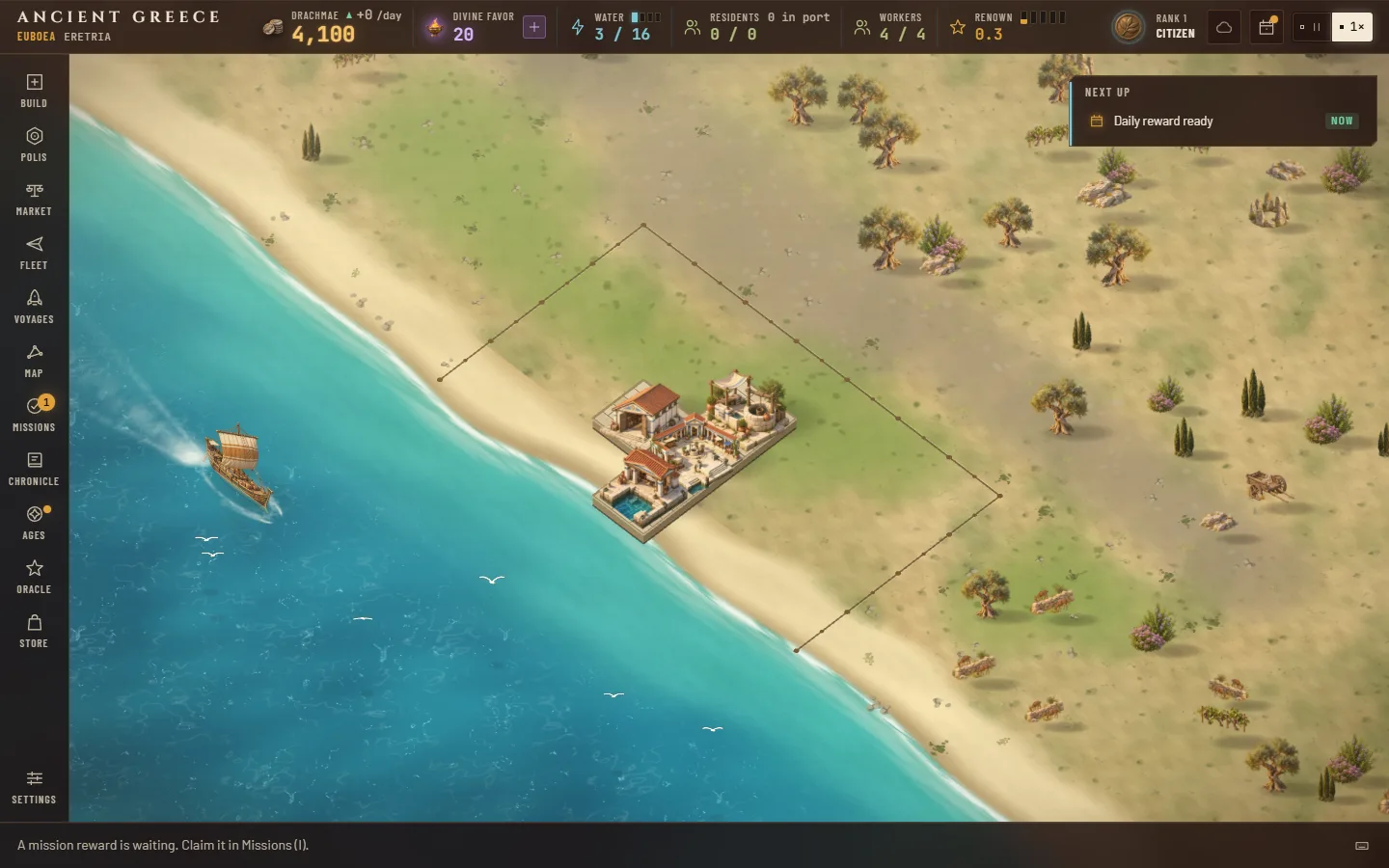
Every polis starts on a 7×5 plot of 35 cells around its Agora. The rest of the region grid is unclaimed: dim, hatched, overgrown with scrub. You buy it one ring at a time, and workers clear it on a timer.
How rings work
Click any unclaimed cell, or press Expand in the Polis panel's Territory block. The confirm shows the next ring's cells, cost and time; Clear pays the drachmae and starts the clock, Clear now pays the drachmae and skips the clock for Divine Favor at the usual rate. Rings are cleared one at a time, in order, whichever cell you clicked. While a ring clears, a band sweeps along the plot's edge, a timer sits under it, and Next up lists it.
Ring k costs 4,000 × 2.2^(k−1) drachmae and takes 15 min × 1.9^(k−1), half again as long in far regions. A ring grows the plot by one cell on each side the grid allows; on the wide home grid the width grows every ring and the height every other ring, which is why the plot goes 7×5, 9×7, 11×7, 13×9, 15×9.
| Ring | Plot after | New cells | Cost | Time | Far regions | Skip |
|---|---|---|---|---|---|---|
| 1 | 9×7 | +28 | 4,000 | 15 min | 22 min 30 s | 2 Favor |
| 2 | 11×7 | +14 | 8,800 | 28 min 30 s | 42 min 45 s | 4 Favor |
| 3 | 13×9 | +40 | 19,360 | 54 min | 1 h 21 min | 7 Favor |
| 4 | 15×9, the whole of a 15×9 grid | +18 | 42,592 | 1 h 43 min | 2 h 34 min | 13 Favor |
| 5 | 17×9, 15×11 or 17×11: Thrace, Ionia, Cyrene, Sicily, Nile Delta | +18 / +30 / +52 | 93,702 | 3 h 15 min | 4 h 53 min | 25 Favor |
| 6 | 19×11: Nile Delta only | +22 | 206,145 | 6 h 11 min | 9 h 17 min | 47 Favor |
Skip prices are for a ring started from scratch; the game charges for the minutes actually left. The Territory block in the Polis panel reads "Starting plot" before the first ring, then "Ring k of 4" on a 15×9 grid (of 5 on 17×9, 15×11 and 17×11; of 6 on 19×11).
Clearing your first ring is a Founding mission (Clear Your First Ring, 1,500 drachmae, 5 Favor); ring 4 is a Town mission (Room to Grow, 12,000 drachmae, 8 Favor). The Landholder achievement counts rings cleared across every polis you own: 2, 10 and 30.
When no empty cell inside the plot touches the polis, the Build panel's tier heads say Needs more plot. That is your cue.
11The Greek worldEight regions · one purse
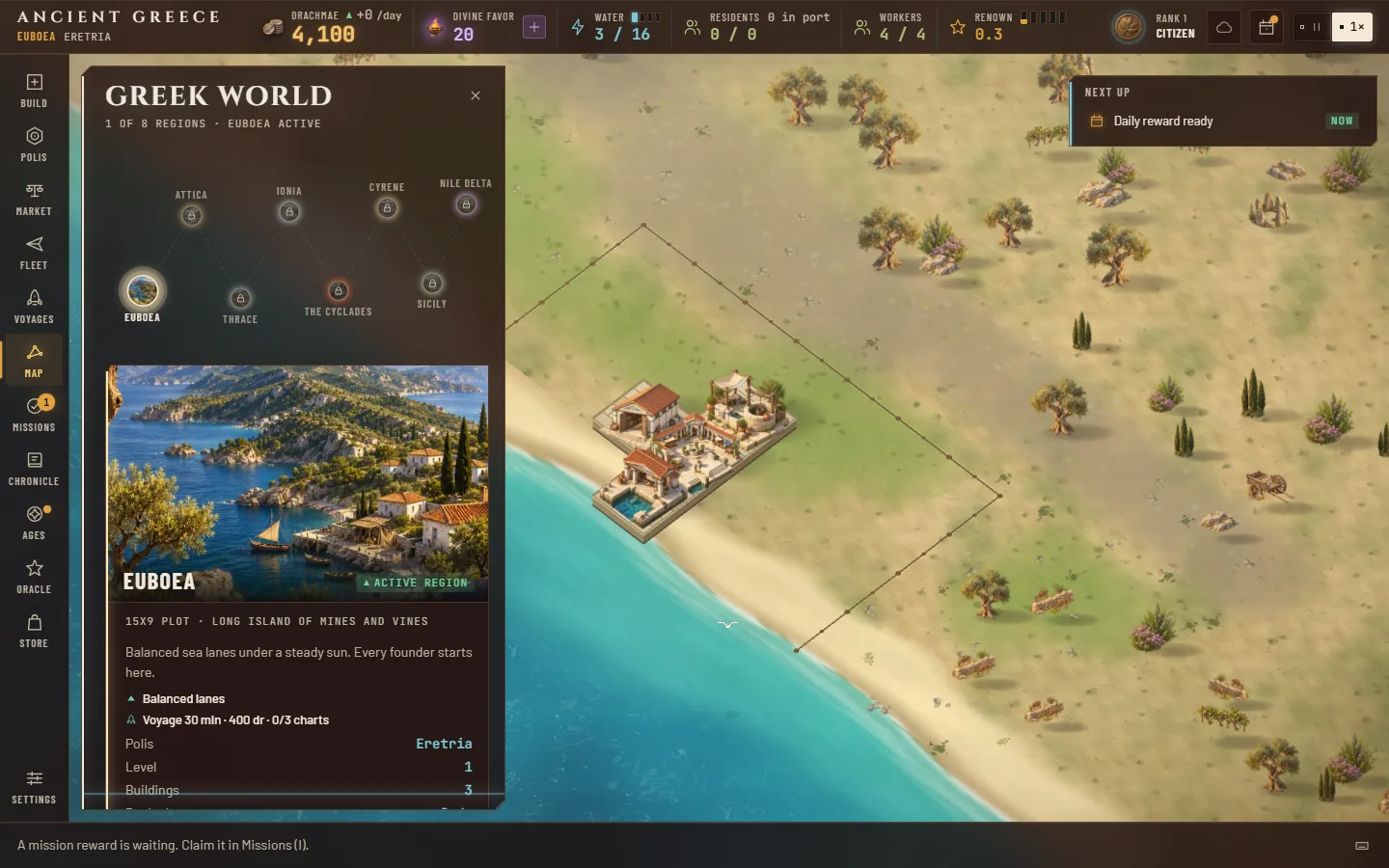
There are eight regions, each with its own coast, its own economy bias and its own polis. You start in Euboea. The others are visible from day one on the map, with their locks. Unlocking one is a voyage in itself: a new agora on a new plot.
One purse, many poleis
Drachmae are shared across every region. Each polis keeps its own name and register, grid, plot, buildings, renown, level, stock, merchant houses and log. Banks fill in every region at once. Divine Favor, rank, missions, achievements, charts and the Chronicle belong to you, not to a polis.
To travel, open the Map, pick an owned region and press Travel. The new polis's banks and timers are settled as you arrive. The panel stays open on return so you can hop straight back.
Unlocking a region
Each region asks for three things: a polis level you have reached in any region, a drachma price, and for some, charts of that region brought home by voyages. Attica can also be opened at once for 60 Divine Favor, and the Nile Delta by the Region Pass; the pass opens every region. The map's lock text tells you exactly what is missing.
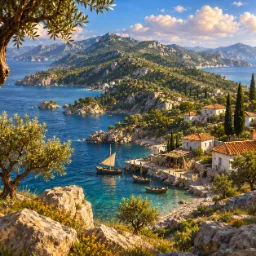 EuboeaLong island of mines and vines
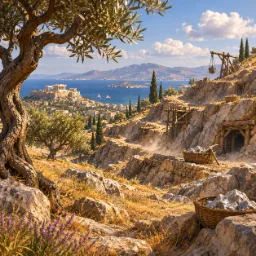 AtticaDry hills, thin soil, silver mines
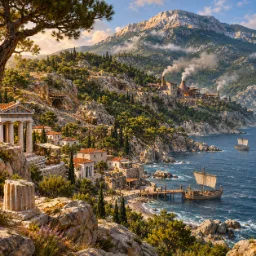 ThraceForested coast under Mount Pangaion
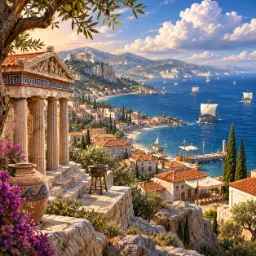 IoniaLong bays and open sea
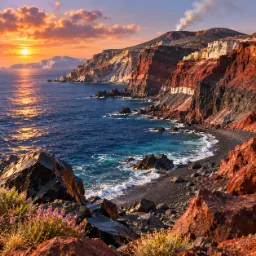 The CycladesVolcanic islands, black obsidian
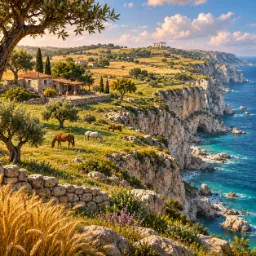 CyreneGreen plateau above the Libyan shore
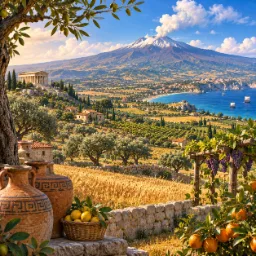 SicilyFertile island under Etna
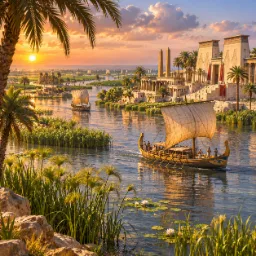 Nile DeltaBroad river mouths, white-walled temples
| Region | Land | Grid | Bias | Unlock |
|---|---|---|---|---|
| Euboea. Balanced sea lanes under a steady sun. Every founder starts here. | Long island of mines and vines | 15×9 | Balanced | Start |
| Attica. Thin soil and hard summers. | Dry hills, thin soil, silver mines | 15×9 | Copper and bronze +40% · droughts ×2 · Athens and Chalcis ×1.5 | Level 2 and 90,000 dr, or 60 Favor |
| Thrace. The mines under Mount Pangaion. Pure mining. | Forested coast under Mount Pangaion | 17×9 | Copper and silver +30% · foundry +50% · no residents · Chalcis ×2 | Level 2, 300,000 dr and 1 chart |
| Ionia. Long bays and open water. | Long bays and open sea | 15×11 | Salt, grain and fruit +40% · Miletus ×2.5 | Level 3 and 1,100,000 dr |
| The Cyclades. Fire-born islands and black glass. Far region. | Volcanic islands, black obsidian | 15×9 | Provisions +50% · pirates ×2 · Tyre ×2.5 · timers ×1.5 | Level 3, 1,200,000 dr and 1 chart |
| Cyrene. A green plateau above the Libyan shore. Far region. | Green plateau above the Libyan shore | 17×11 | Fine wares +40% · provisions +40% · festivals ×2 · Cyrene ×2 · timers ×1.5 | Level 3, 1,500,000 dr and 2 charts |
| Sicily. Green from shore to shore. Far region. | Fertile island under Etna | 17×11 | Grain, fruit and livestock +20% · residents grow ×2 · rent +30% · Syracuse ×2 · timers ×1.5 | Level 4 and 3,000,000 dr |
| Nile Delta. The far end of the sea road. Far region. | Broad river mouths, white-walled temples | 19×11 | Silver and frankincense +30% · beacon traffic ×2 · Naucratis ×2 · timers ×1.5 | Level 4, 5,500,000 dr and 3 charts, or the Region Pass |
"Timers ×1.5" means builds, upgrades and ring clearings in that region take half again as long. A house multiplier weights how often its vessels choose that region.
What the pacing expects
The prices are set for a founder who plays three sessions of about fifteen minutes a day and taps the banks each time. On that pace the tuning run reached Attica on day 2, Thrace on day 4, Ionia on day 9, the Cyclades on day 14, Cyrene on day 21, Sicily on day 27 and the Nile Delta on day 36, with level 4 arriving around day 22. Play more often and the banks cap you; play less and nothing is lost, the timers just finish without you.
Each new polis starts the same way: an agora, 7×5 of plot, tier 1 open, and the tutorial's three instant builds already spent. The new polis's name comes from the region's own list; rename it in the Polis panel if you like.
12VoyagesCharts · cargo · discoveries
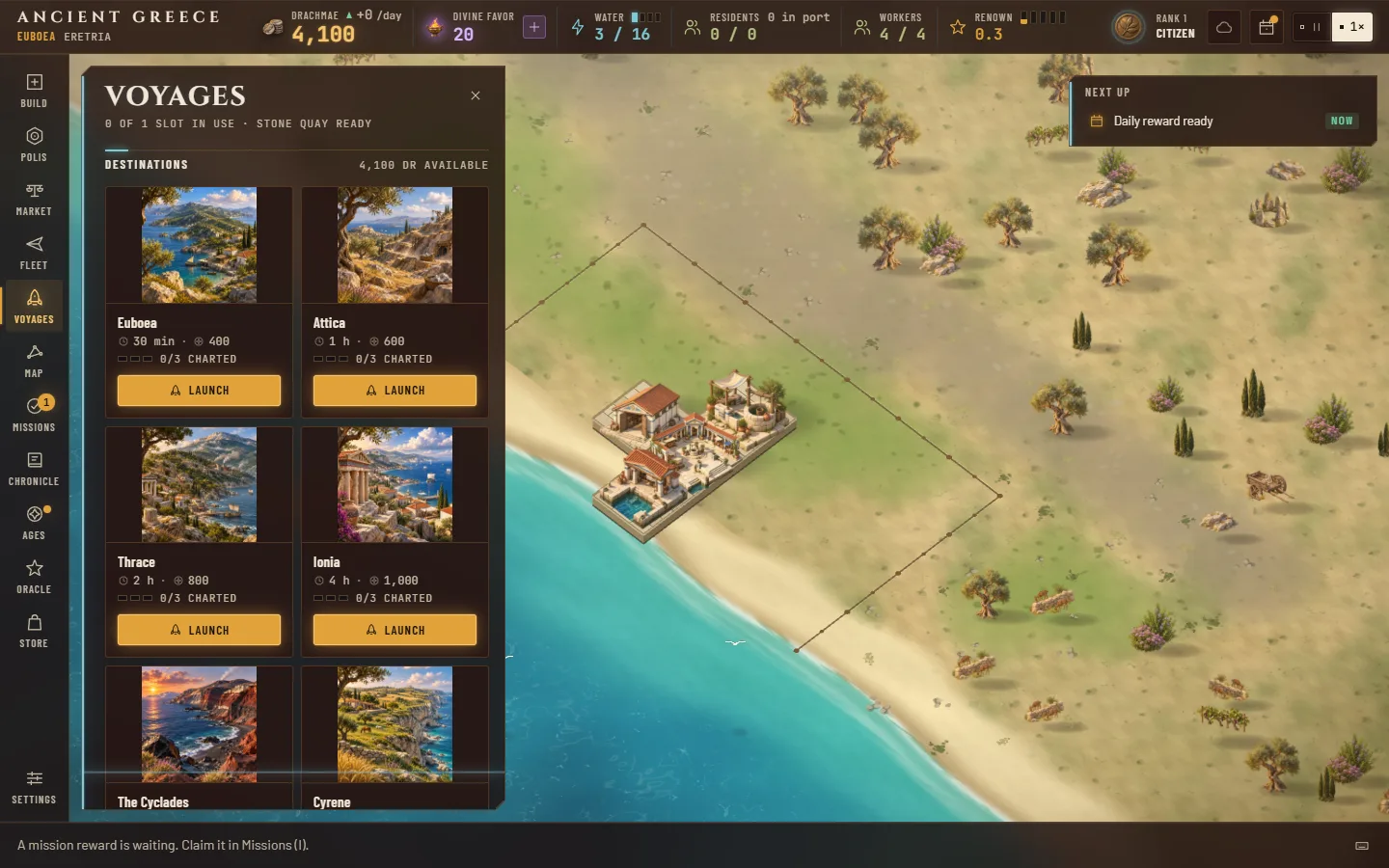
A voyage is a vessel sent from your quays to any region, locked or not. It takes real time, from half an hour to a full day, and comes back with cargo, usually a chart, and sometimes Divine Favor, drachmae or a discovery for the Chronicle.
Slots and requirements
You need an active Stone Quay. You have one slot, a second with a Heralds' Hall and a third with a Shipyard; three is the most. Only one vessel can be out to a given region at a time. Launching costs drachmae up front; the vessel sails from whatever polis you launched it from, and the haul comes home to the polis you are at when you debrief.
| Region | Duration | Cost | Cargo on return | Full-skip price |
|---|---|---|---|---|
| Euboea | 30 min | 400 | Copper Ore, Raw Silver, Grain | 4 Favor |
| Attica | 1 h | 600 | Copper Ore, Bronze Ingots, Fine Wares | 8 Favor |
| Thrace | 2 h | 800 | Copper Ore, Raw Silver, Bronze Ingots | 15 Favor |
| Ionia | 4 h | 1,000 | Sea Salt, Figs and Grapes, Exotic Animals | 30 Favor |
| The Cyclades | 6 h | 1,200 | Frankincense, Woven Cloth, Copper Ore | 45 Favor |
| Cyrene | 8 h | 1,400 | Fine Wares, Medicine, Figs and Grapes | 60 Favor |
| Sicily | 12 h | 1,600 | Grain, Figs and Grapes, Livestock | 90 Favor |
| Nile Delta | 24 h | 1,800 | Fine Wares, Medicine, Raw Silver | 180 Favor |
Cost is 400 drachmae plus 200 per step out from home. Return brings sailors home early at 1 Favor per eight minutes left; the price shown is for a vessel that has only just left.
The debrief
When the vessel is back the Voyages rail badge lights, Next up says Debrief, and a toast offers it. Pressing Debrief rolls the haul and plays it as a row of chips:
- Cargo, always: 20 to 80 units split evenly across the region's three goods, into your current polis's stock. Whatever does not fit is brokered at half price.
- A chart, 60% of the time, and guaranteed on every third claimed run to that region (the 3rd, 6th, 9th). Three charts fully chart a region; Thrace, the Cyclades, Cyrene and the Nile Delta need one, one, two and three to unlock.
- Divine Favor, 35% of the time: 1 to 8, weighted toward the low end.
- A discovery, 45% of the time: a vessel, people or antiquity from that region's pool, drawn common 6 : rare 3 : epic 1, and always something you have not found yet while any remain.
- Drachmae, 20% of the time: five to fifteen minutes of your total polis rate.
Every debrief pays 20 rank XP and counts toward the Navigator achievement; charts count toward Cartographer. The panel keeps your last five debriefs.
13The lie of the landSea · waterfront · valley · hills
Every region is laid out the same way: open land, then one long row of waterfront, then the sea. The Agora stands one row above it, and nothing can be built on the sea.
Waterfront is kept for the buildings that work with vessels. Stone Quay must stand on it. Storehouse, Chandlery, Customs House, Emporion, Shipyard and Great Beacon may stand there too, or inland. Anything else is refused, and the hint under your cursor says why.
What the ground gives
A building on the right ground does more of what it does, and its bank earns a smaller part of the same bonus: 30% of it.
| Ground | Favours | Output | Bank |
|---|---|---|---|
| Fertile valley | food and foundries | +25% | +7.5% |
| Hill country | civic life | +25% | +7.5% |
| Hill country | defence | +25% | +7.5% |
| The waterfront | trade | +5% | +1.5% |
Each region has its own ground
The land behind the shore differs from region to region, and it never changes once you have seen it. These are the shares of each region's open land.
| Region | Fertile valley | Hill country |
|---|---|---|
| Euboea | 24% | 26% |
| Attica | 12% | 42% |
| Thrace | 20% | 34% |
| Ionia | 30% | 20% |
| The Cyclades | 10% | 52% |
| Cyrene | 42% | 16% |
| Sicily | 46% | 20% |
| Nile Delta | 62% | 4% |
14Ages and discoveriesFive ages · sixteen discoveries
A building tier now needs two things: the polis level it always needed, and the discovery that opens its age. Open Ages from the rail to see what you know and what comes next.
| Age | Opened by | What it opens |
|---|---|---|
| Dark Age | You start here | Tier 1 · Fishing Harbour |
| Archaic Age | The Alphabet | Tier 2 · Trading Port |
| Classical Age | The Lawgiver | Tier 3 · Walled Town |
| Hellenistic Age | The Elements | Tier 4 · Sea Power |
| Age of Legend | The Hellenistic Synthesis | Nothing new to build: this one crowns the game |
How study works
- One study runs at a time, and you pay for it when it starts.
- It runs on a real timer, like a build, and it finishes while the tab is closed. With notifications on in Settings, you get one when it does.
- Divine Favor can finish a study at the same price as skipping a build.
- Wisdom you have studied is never lost, and it holds in every region you settle.
| Discovery | Cost | Time | Needs | What it does |
|---|---|---|---|---|
| Dark Age | ||||
| Sailcraft | 1,500 dr | 5 min | Nothing | +4% trade |
| The Alphabet | 2,500 dr | 8 min | Nothing | Opens Trading Port buildings |
| Terraced Fields | 6,000 dr | 15 min | Nothing | +10% settlers; +5% food and foundries |
| Archaic Age | ||||
| Coinage | 20,000 dr | 45 min | The Alphabet | +2% earnings |
| The Lawgiver | 20,000 dr | 30 min | The Alphabet; level 2 | Opens Walled Town buildings |
| The Phalanx | 30,000 dr | 1 h | The Lawgiver | +25% defence |
| The Trireme | 40,000 dr | 2 h | Sailcraft, Coinage | +1 Quay at every quay |
| Classical Age | ||||
| Democracy | 120,000 dr | 3 h | The Lawgiver | +10% homes; +4 workers |
| Rational Medicine | 150,000 dr | 4 h | Terraced Fields, Democracy | +15% settlers; +3% civic life |
| Geometry | 220,000 dr | 5 h | Coinage | −8% build time |
| Philosophy | 260,000 dr | 6 h | Democracy | −15% study time; +1.1 renown |
| The Elements | 200,000 dr | 4 h | Geometry, Philosophy; level 4 | Opens Sea Water buildings |
| Hellenistic Age | ||||
| The Pharos | 350,000 dr | 6 h | The Elements | +5% vessels calling; Allows Great Beacon |
| The Great Library | 900,000 dr | 10 h | Philosophy, The Elements | −15% study time; +15% settlers |
| Astronomy | 1,400,000 dr | 12 h | The Pharos | +2% trade |
| The Hellenistic Synthesis | 2,200,000 dr | 24 h | Rational Medicine, The Great Library, Astronomy, The Phalanx, The Trireme; level 4 | +10% homes; +0.3 renown |
15WorkersJobs · households · hiring order
Almost every building hires workers. The Agora's own households supply 18, which covers the whole opening, and every resident after that is one more pair of hands. The readout beside your residents shows citizens at work against jobs on offer.
A building short of workers runs at its share: half its workers means half its output and half its bank. A scaffold hires nobody until it opens. The Agora and houses hire nobody at all.
The hiring order
When there are not enough citizens to go round, the groups are served in this order. Open Workers from the readout to move a group up or down; Reset puts them back.
| Group | Buildings |
|---|---|
| Water | Village Well and Aqueduct |
| Food and healing | Tavern, Terrace Gardens and Asklepion |
| Harbour | Stone Quay, Storehouse, Chandlery, Harbour Inn, Shipyard and Great Beacon |
| Commerce | Emporion, Customs House, Heralds' Hall and Trapeza Bank |
| Civic life | Theatre, Academy, Stoa, Animal Garden, Hilltop Temple and Hoplite Post |
| Industry | Bronze Foundry |
| Building | Level 1 | Level 2 | Level 3 |
|---|---|---|---|
| Storehouse | 1 | 1 | 2 |
| Village Well | 1 | 1 | 2 |
| Stone Quay | 2 | 3 | 3 |
| Chandlery | 2 | 3 | 3 |
| Harbour Inn | 2 | 3 | 3 |
| Tavern | 2 | 3 | 3 |
| Heralds' Hall | 3 | 4 | 5 |
| Customs House | 3 | 4 | 5 |
| Hoplite Post | 3 | 4 | 5 |
| Emporion | 4 | 5 | 6 |
| Theatre | 4 | 5 | 6 |
| Terrace Gardens | 4 | 5 | 6 |
| Asklepion | 4 | 5 | 6 |
| Aqueduct | 4 | 5 | 6 |
| Academy | 4 | 5 | 6 |
| Trapeza Bank | 4 | 5 | 6 |
| Animal Garden | 4 | 5 | 6 |
| Hilltop Temple | 4 | 5 | 6 |
| Stoa | 5 | 6 | 8 |
| Bronze Foundry | 6 | 8 | 9 |
| Shipyard | 6 | 8 | 9 |
| Great Beacon | 10 | 13 | 15 |
No one settles in Thrace, so 60 hired hands from elsewhere work it on top of the usual households.
16The OracleProphecies · blessings · prices
The Pythia at Delphi speaks when she chooses: first about 5 game days after founding, and then 7 to 12 game days after each blessing fades. Press O or open the Oracle from the rail.
Each prophecy offers two blessings. Each blessing has a price and a length in game days, and it acts through the same effects as a discovery. Only one rests on the city at a time.
- Nothing waits on your answer. The offer stays until you take it or let it pass, and the city carries on meanwhile.
- Letting a prophecy pass costs nothing at all.
- Some blessings ask for an offering, paid at once and sized to what the whole city earns in that many minutes.
| Blessing | What it gives | The price | Game days |
|---|---|---|---|
| Hermes' Errand | Vessels call far more often. | Goods spoil in the rush: storehouses hold less. | 12 |
| Poseidon's Calm | Flat water: every quay moors another vessel. | A bull for the god, paid now. (12 minutes of the whole city's earnings) | 12 |
| Demeter's Bounty | Fields and foundries give far more. | A glut: everything sells for less. | 14 |
| Athena's Counsel | Scholars see the answer sooner. | Citizens debate instead of working: coffers fill slower. | 14 |
| Apollo's Light | Your renown spreads through the Greek world. | Pilgrims crowd out the rent-payers. | 12 |
| Dionysus' Revels | A festival begins at once: visitors spend freely. | The harbour is hungover: fewer vessels call. | 8 |
| Hephaestus' Forge | Builders finish a fifth sooner. | Every hand is on a scaffold, not the quays. | 12 |
| Ares' Vigil | Guards double their worth and raiders stay away. | Soldiers quartered in homes: rents fall. | 16 |
| Hestia's Hearth | Room for more, and families come to fill it. | Land goes to houses: markets thin out. | 16 |
| The Staff of Asclepius | Civic life flourishes. People feel well. | A gift to the sanctuary, paid now. (10 minutes of the whole city's earnings) | 14 |
| Zeus' Favor | Every coffer fills faster. | Those the god watches, his enemies watch too: droughts and raids grow likelier. | 12 |
| Tyche's Wheel | A windfall now: twenty minutes of the whole city's earnings. | Fortune collects later: coffers fill slower. | 10 |
17Missions and achievements50 goals · 24 achievements
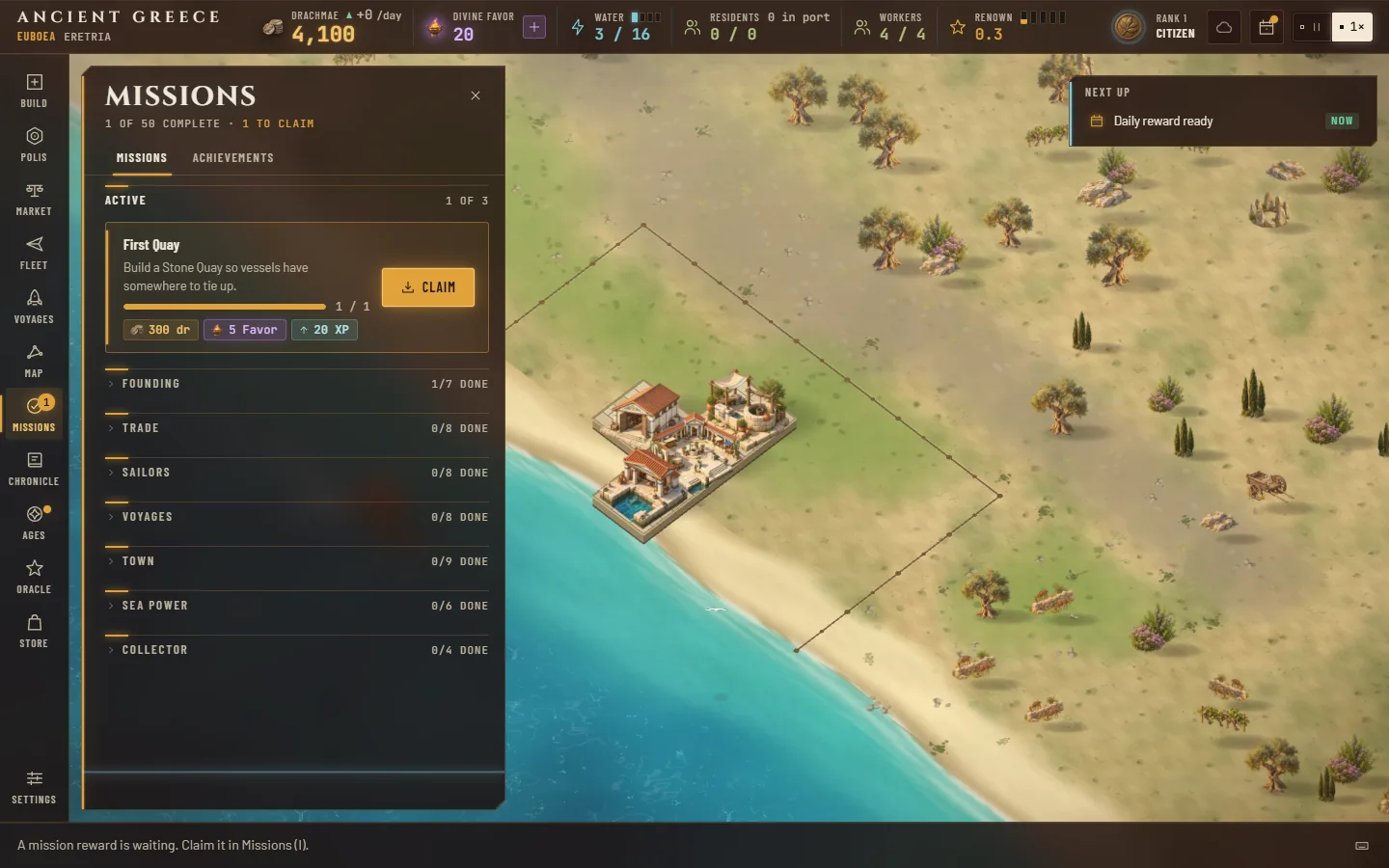
Missions are chapter goals for the polis you are at; achievements are lifetime milestones across your whole career. Both pay out only when you come back and press Claim, and the Missions rail button counts everything waiting.
Missions
Fifty missions in seven chapters. Three are active at a time: the next unclaimed mission of each open chapter, in chapter order, with a fourth slot from civic rank 4. A chapter opens when its first mission's prerequisite is met. Progress is checked a few times a second as you play; a completed mission toasts you with a Claim button, and claiming flies the drachmae and Divine Favor to the status bar. Altogether the missions pay 344,600 drachmae, 411 Divine Favor and 4,980 rank XP.
| Mission | Goal | Drachmae | Favor | XP |
|---|---|---|---|---|
| Founding · the tutorial · 7 missions · 35 Favor | ||||
| First Quay | Build a Stone Quay | 300 | 5 | 20 |
| Room to Breathe | Build a Storehouse | 300 | 5 | 20 |
| First Water | Build a Village Well | 400 | 5 | 20 |
| Tap the Bank | Collect a bank | 500 | 5 | 20 |
| Open for Business | Serve three vessels | 600 | 5 | 30 |
| Incoming Dispatch | Read a dispatch | 500 | 5 | 30 |
| Clear Your First Ring | Clear ring 1 of the plot | 1,500 | 5 | 40 |
| Trade · 8 missions · 42 Favor · opens after Open for Business | ||||
| Pitch and Rope | Build a Chandlery | 600 | 2 | 30 |
| Moving Cargo | Trade 500 units of cargo over your quays | 1,200 | 3 | 40 |
| The Exchange | Build an Emporion | 1,500 | 3 | 40 |
| Regular Traffic | Serve 25 vessels at this polis | 2,000 | 4 | 60 |
| Paperwork | Build a Customs House | 2,000 | 4 | 60 |
| Black Ink | Earn 50,000 drachmae of gross income at this polis | 4,000 | 5 | 80 |
| Bulk Lanes | Trade 5,000 units of cargo | 6,000 | 6 | 100 |
| Convoy Season | Serve 15 vessels during a weekly Convoy window | 8,000 | 15 | 120 |
| Sailors · 8 missions · 33 Favor · opens after First Water | ||||
| Cots | Build a Harbour Inn | 500 | 2 | 30 |
| Hot Meals | Build a Tavern | 600 | 2 | 30 |
| Shore Leave | Build a Theatre | 1,200 | 3 | 40 |
| Good Harbour | Raise quality of life to 70% | 2,000 | 4 | 60 |
| Trusted Partner | 75 trust with any merchant house | 2,500 | 4 | 60 |
| House of Healing | Build an Asklepion | 2,000 | 4 | 60 |
| Three Offices | Have three merchant houses keep offices in the polis | 5,000 | 6 | 100 |
| Slipway | Build a Shipyard | 8,000 | 8 | 120 |
| Voyages · 8 missions · 68 Favor · opens after Open for Business | ||||
| First Sailing | Launch a voyage from the Voyages panel | 600 | 3 | 30 |
| Debrief | Debrief a returned voyage | 800 | 3 | 40 |
| Charted | Hold a chart of any region | 1,500 | 4 | 60 |
| Second Slot | Build a Heralds' Hall | 2,000 | 4 | 60 |
| Field Notes | Make three discoveries for the Chronicle | 3,000 | 6 | 80 |
| A Second Harbour | Unlock a second region on the world map | 5,000 | 25 | 150 |
| Fully Charted | Hold three charts of one region | 8,000 | 8 | 120 |
| Four Harbours | Unlock four regions | 20,000 | 15 | 200 |
| Town · 9 missions · 57 Favor · opens after Good Harbour | ||||
| Settlers | Build Courtyard Houses | 1,500 | 3 | 40 |
| A Village | House 10 permanent residents | 2,000 | 4 | 60 |
| Green Terraces | Build Terrace Gardens | 2,000 | 4 | 60 |
| Walled Town | Reach polis level 3 | 5,000 | 10 | 150 |
| Academy | Build an Academy | 4,000 | 5 | 80 |
| Room to Grow | Clear ring 4 of this polis's plot | 12,000 | 8 | 120 |
| The Stoa | Build a Stoa | 5,000 | 5 | 80 |
| A Town | House 50 permanent residents | 10,000 | 8 | 120 |
| Money-Changers | Build a Trapeza Bank | 12,000 | 10 | 150 |
| Sea Power · 6 missions · 128 Favor · opens after Walled Town | ||||
| Far Sight | Build a Hilltop Temple | 8,000 | 8 | 120 |
| Sea Power | Reach polis level 4 | 15,000 | 15 | 200 |
| Beacon | Build a Great Beacon | 20,000 | 15 | 200 |
| Great Galley Call | Serve a Naucratis Grand Fleet galley | 25,000 | 20 | 250 |
| Six Harbours | Unlock six regions | 40,000 | 20 | 300 |
| End of the Sea Road | Unlock the Nile Delta, the end of the sea road | 60,000 | 50 | 500 |
| Collector · 4 missions · 48 Favor · opens after Debrief | ||||
| Spotter | Log six vessel variants in the Chronicle | 3,000 | 5 | 80 |
| Guest-Friend | Log four visiting peoples | 5,000 | 8 | 120 |
| Curator | Recover four antiquities | 8,000 | 10 | 150 |
| Complete Set | Complete any Chronicle set | 15,000 | 25 | 250 |
Build and level goals count the polis you are at; region, chart and Chronicle goals count your profile. Convoy Season needs the weekly Convoy window: 48 hours every seven days, counted from when your profile was created, starting with the second week.
Achievements
Twenty-four lifetime achievements, each with a bronze, silver and gold tier. Bronze pays 5 Divine Favor, silver 15, gold 40, and the nine hardest golds pay 60: 1,600 Divine Favor in all. They track your whole profile, every region included, and one tier is claimed per press of Claim.
| Achievement | Counts | Bronze · 5 Favor | Silver · 15 Favor | Gold · 40 Favor |
|---|---|---|---|---|
| Harbourmaster | Vessels served | 50 | 500 | 5,000 · 60 Favor |
| Banker | Drachmae collected from banks | 50,000 | 1,000,000 | 20,000,000 · 60 Favor |
| Architect | Building projects completed | 10 | 100 | 500 |
| Foreman | Upgrades completed | 5 | 50 | 200 |
| Navigator | Voyages debriefed | 3 | 25 | 150 |
| Cartographer | Charts held, all regions | 3 | 12 | 24 |
| Collector | Chronicle entries found | 10 | 30 | 52 · 60 Favor |
| Pioneer | Regions owned, home included | 2 | 5 | 8 · 60 Favor |
| Landholder | Plot rings cleared, all poleis | 2 | 10 | 30 |
| Regular | Daily rewards claimed | 7 | 30 | 100 |
| Patron | Divine Favor earned in play | 50 | 500 | 5,000 |
| Town Planner | Residents, peak at one polis | 20 | 60 | 150 |
| Harbour Keeper | Regions at level 2 or more | 1 | 3 | 8 |
| Port Warden | Regions at level 3 or more | 1 | 3 | 8 |
| Town Founder | Regions at level 4 or more | 1 | 3 | 8 · 60 Favor |
| Great City Archon | Regions at level 5 | 1 | 3 | 8 · 60 Favor |
| Rising Citizen | Civic rank | 2 | 3 | 4 |
| Leading Citizen | Civic rank | 5 | 6 | 7 |
| Legend of the Aegean | Civic rank | 8 | 9 | 10 · 60 Favor |
| Quartermaster | Cargo units traded, all poleis | 1,000 | 20,000 | 200,000 |
| Magnate | Gross income, all poleis | 100,000 | 2,000,000 | 50,000,000 · 60 Favor |
| Great Galley Host | Naucratis galleys served | 1 | 10 | 100 |
| Convoy Master | Vessels served in Convoy windows | 15 | 100 | 500 |
| Impatient | Timers finished with Divine Favor | 5 | 50 | 300 |
18Daily reward and civic rankA seven-day streak · ten ranks
Two systems reward simply showing up: a daily streak that resets at local midnight, and a civic rank that grows with everything you do and is yours across every region.
The daily reward
Once per calendar day, in your local time, a reward is claimable: from the sheet that opens when you start, from the bell in the status bar, or from the Next up strip. Claim on consecutive days and the streak climbs through a seven-day loop, then starts again at day 1 with the streak count still rising.
| Day | Reward | How it scales |
|---|---|---|
| 1 | 1,500+ drachmae | 30 minutes of your total polis rate, never less than 1,500 |
| 2 | 3,000+ drachmae | 60 minutes of your total polis rate, never less than 3,000 |
| 3 | 5 Divine Favor | — |
| 4 | 6,000+ drachmae | 120 minutes of your total polis rate, never less than 6,000 |
| 5 | Goods crate | 60 units of the active region's voyage goods, into stock (overflow brokered) |
| 6 | 10 Divine Favor | — |
| 7 | 25 Divine Favor + banner token | — |
Miss a single day and nothing happens: claiming the day after continues the streak. Miss two days or more and the streak is broken; your next claim starts again at day 1, unless you repair it for 5 Divine Favor. The repair offer appears on the daily sheet for 48 hours from the moment the streak broke (the start of the second missed day). Daily claims count toward the Regular achievement.
Civic rank
Rank is experience, earned profile-wide and never lost. You gain 1 XP for every 100 drachmae collected from banks, 5 for every vessel served, 20 for every voyage debriefed, 15 for every first discovery, 100 for every polis level reached, and the XP a mission lists. Each promotion pays Divine Favor equal to ten times the new rank and celebrates across the screen with the new badge. That badge then sits in the status bar's ring, which fills toward the next rank; hover it for the exact figures and the next grant.
| Rank | Title | XP | Grants | Favor on promotion |
|---|---|---|---|---|
| 1 | Citizen | 0 | Where everyone starts | — |
| 2 | Councillor | 300 | — | 20 |
| 3 | Harbourmaster | 900 | Collect all: every bank in the polis in one press | 30 |
| 4 | Trierarch | 2,000 | A fourth mission slot | 40 |
| 5 | Strategos | 4,500 | +5% bank rate, and caps, everywhere | 50 |
| 6 | Navarch | 7,500 | Title | 60 |
| 7 | Warden of the Sea Lanes | 10,500 | Title | 70 |
| 8 | Archon | 13,500 | Title | 80 |
| 9 | Voice of the Assembly | 16,500 | Title | 90 |
| 10 | Archon of the Aegean | 19,500 | The top rank | 100 |
Ranks 6 to 10 are 3,000 XP apart. The three rank achievements, Rising Citizen, Leading Citizen and Legend of the Aegean, pay out alongside the promotions.
19The Chronicle24 vessels · 12 peoples · 16 antiquities
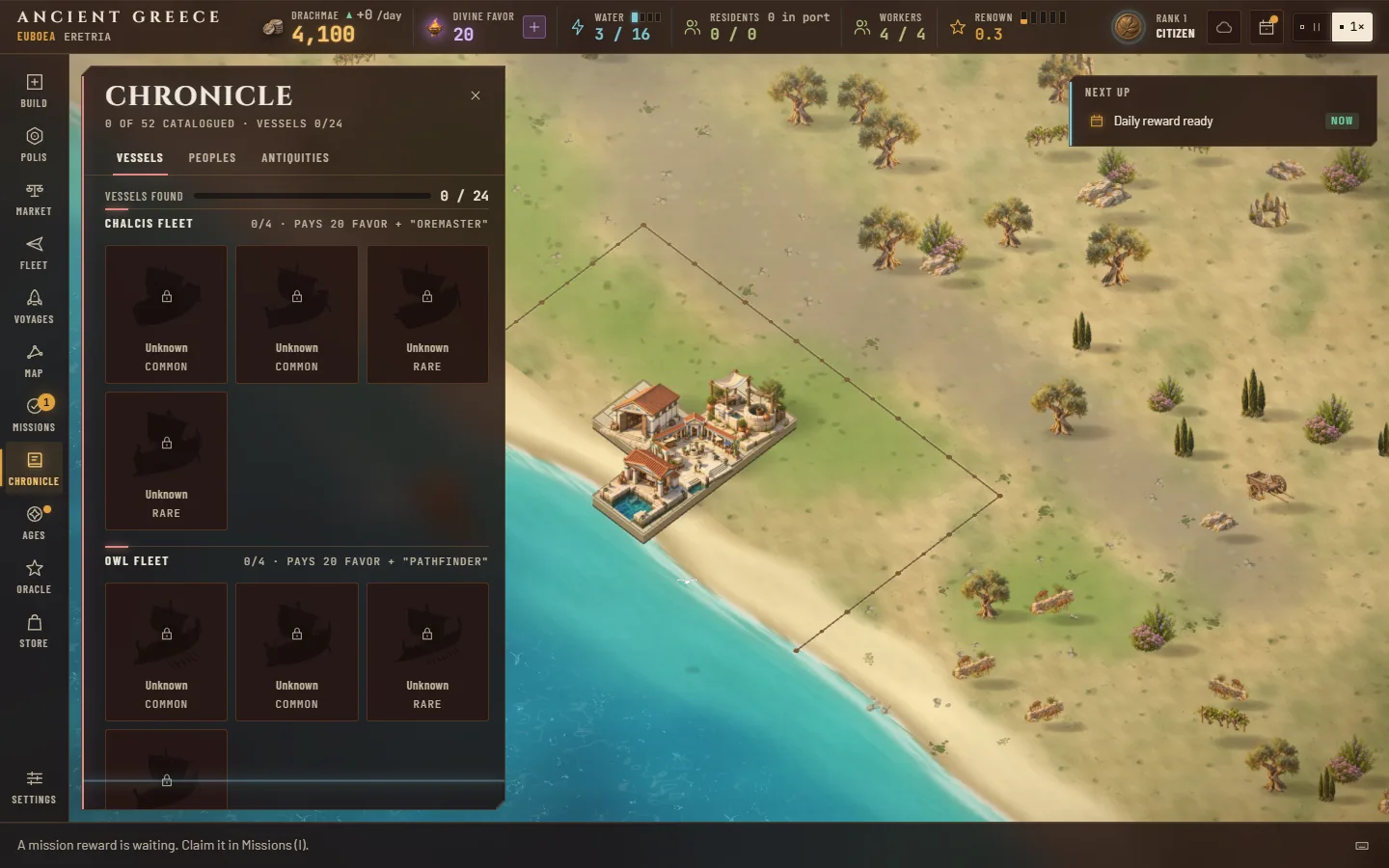
The Chronicle (R) is your collection: fifty-two things to find, each with two lines of story, shown dark behind a lock until you log them, then in colour. Click any card for its full picture and story. Sets pay Divine Favor and a title.
Vessels
Twenty-four hulls across the seven houses. The twelve standard vessels are logged the first time you serve one of that house and class, from the Chalcis Round Hulk to the Naucratis Great Galley. Six notable hulls appear when a house's tenth vessel moors at the polis you are at: the Anvil of Chalcis, Swift Owl, Green Serpent, Harvest Moon, Storm Runner and Deep Tide. The other six come home with voyages: Ore-Mother from Euboea or Attica, Blue Shrike from Attica, Brine Queen from Ionia, Ember of Tyre from the Cyclades, Plenty of Sicily from Sicily, and the epic Glory of Naucratis from the Nile Delta.
Peoples
Twelve peoples of the ancient Mediterranean, written as the cultures they were. Six are met by serving five vessels of a house: Chalcidian Smiths (Chalcis), Sicel Farmers (Syracuse), Attic Potters (Athens), Carian Mariners (Miletus), Phoenician Merchants (Tyre) and Libyan Horse-breeders (Cyrene). The Egyptian Envoys step off the first great galley. Five are met only by voyages: Thracian Riders in Thrace, Lydian Goldsmiths in Ionia, Eteocretans in the Cyclades, Garamantes in Cyrene and the epic Envoys of Kush in the Nile Delta.
Antiquities
Sixteen antiquities and sacred relics, two per region, voyages only. The second relic of each region is rarer than the first; the Lost Captain's Tablet, the Carneia Cymbals and The First Periplus are epic. A discovery you already hold counts again on its card but is only drawn when the region has nothing new left for you.
Sets
A set completes the moment its last item is logged; the Divine Favor and the title are granted at once and a toast tells you. The Complete Set mission pays a further 25 Favor for your first.
| Set | Items | Pays | Title |
|---|---|---|---|
| Chalcis Fleet | 4 | 20 Favor | Oremaster |
| Owl Fleet | 4 | 20 Favor | Pathfinder |
| Battos Fleet | 2 | 20 Favor | Keeper |
| Syracuse Fleet | 4 | 20 Favor | Harvester |
| Tyrian Fleet | 4 | 20 Favor | Seafarer |
| Milesian Fleet | 4 | 20 Favor | Tidemaster |
| Naucratis Fleet | 2 | 40 Favor | Beaconkeeper |
| Peoples of the Middle Sea | 12 | 60 Favor | Proxenos |
| Relics of Euboea | 2 | 20 Favor | Antiquarian |
| Relics of Attica | 2 | 25 Favor | Silverkeeper |
| Relics of Thrace | 2 | 30 Favor | Salvager |
| Relics of Ionia | 2 | 25 Favor | Deepwarden |
| Relics of the Cyclades | 2 | 25 Favor | Islander |
| Relics of Cyrene | 2 | 30 Favor | Festival Master |
| Relics of Sicily | 2 | 25 Favor | Seedkeeper |
| Relics of the Nile | 2 | 40 Favor | Cartographer |
Sixteen sets, 440 Divine Favor in all. Every first discovery also pays 15 rank XP and counts toward Collector.
20Divine Favor and the StoreOfferings · real prices
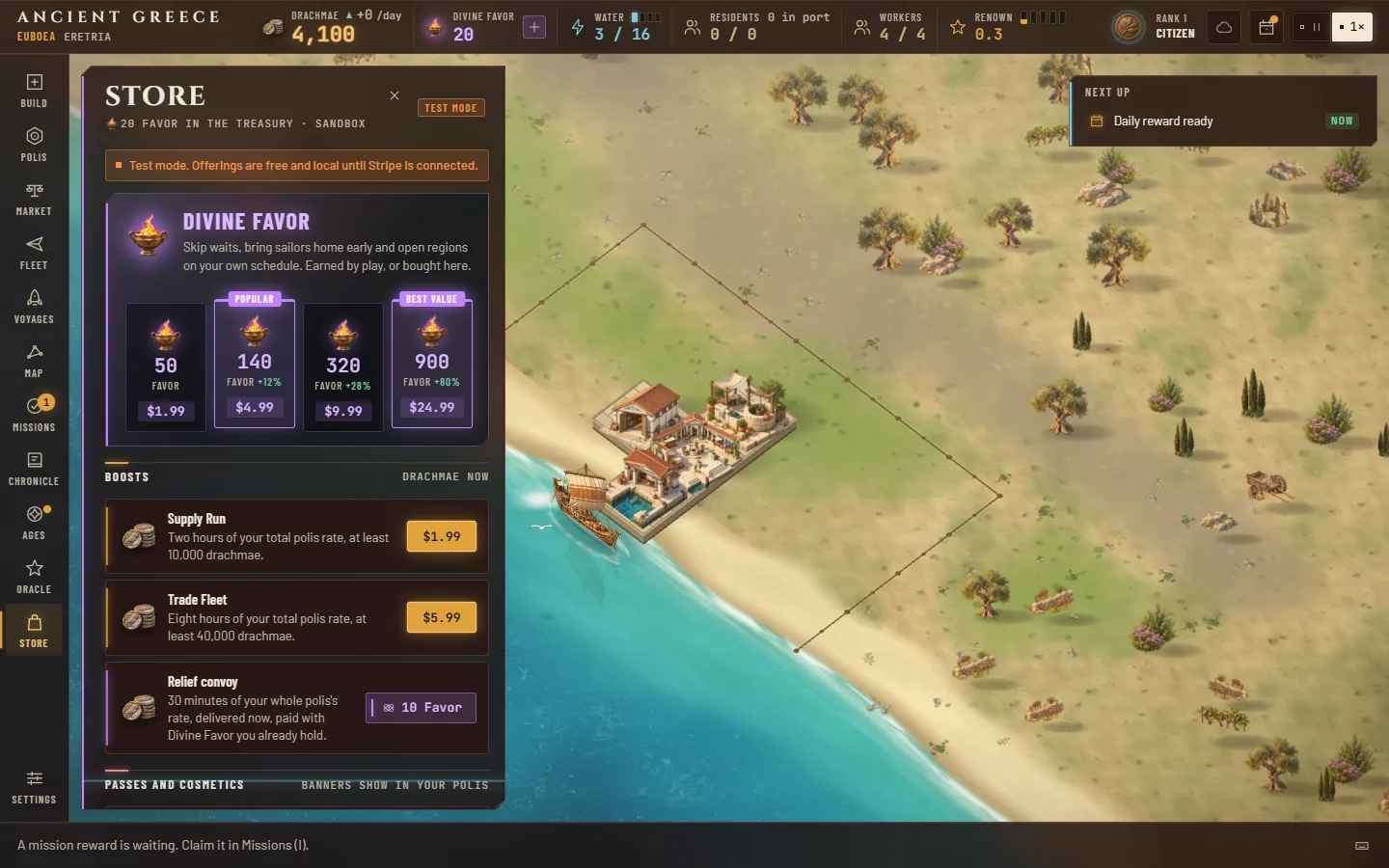
Divine Favor is the premium currency. It is violet wherever it appears, you start with 20, and the game pays it out steadily for playing. It buys time, never access: every building, region, mission and achievement is reachable with drachmae and patience.
 Divine FavorPremium. Earned in play, offered in the Store. Buys time, never access.
 DrachmaeThe working currency. One purse across every region; banks fill it by the minute.
Earning it
- Missions: 2 to 50 each, 411 across all fifty. The tutorial chapter alone pays 35.
- Achievements: 5, 15 and 40 per tier (60 for the hardest golds), 1,600 in all.
- Daily reward: 5, 10 and 25 on days 3, 6 and 7 of the streak.
- Voyages: 1 to 8 about one debrief in three.
- Chronicle sets: 20 to 60 each, 440 in all.
- Promotions: ten times the new rank, 540 from Citizen to Archon of the Aegean.
Spending it
- Skip any timer: builds, upgrades, ring clearings and voyages, at 1 Favor per eight minutes left, minimum 1.
- Open Attica now: 60 Favor instead of level 2 and 90,000 drachmae.
- Repair a daily streak: 5 Favor within 48 hours of the break.
- Relief convoy: 10 Favor for 30 minutes of your whole polis's rate in drachmae, delivered now, from the Store's Boosts shelf.
The Store
| Item | What it grants | Price |
|---|---|---|
| Divine Favor · 50 | A small offering at the altar. | $1.99 |
| Divine Favor · 140 · Popular | 125 plus 15 bonus. | $4.99 |
| Divine Favor · 320 | 250 plus 70 bonus. | $9.99 |
| Divine Favor · 900 · Best value | 500 plus 400 bonus. | $24.99 |
| Supply Run | Two hours of your total polis rate, at least 10,000 drachmae. | $1.99 |
| Trade Fleet | Eight hours of your total polis rate, at least 40,000 drachmae. | $5.99 |
| Region Pass | Every region unlocked for this profile. No charts needed. | $9.99 |
| Founder's Banner | An ivory-amber banner, the title Founder, and 100 Divine Favor. | $4.99 |
| Region Banners | The six region banners for your polis. | $2.99 |
Prices are in US dollars. Divine Favor is a game currency with no cash value and cannot be refunded or transferred. Drachma boosts and the Relief convoy are measured against the rate of the polis you are at. Calling a purchase an offering is flavour; it is an ordinary payment, and the price is shown before you pay.
Banners
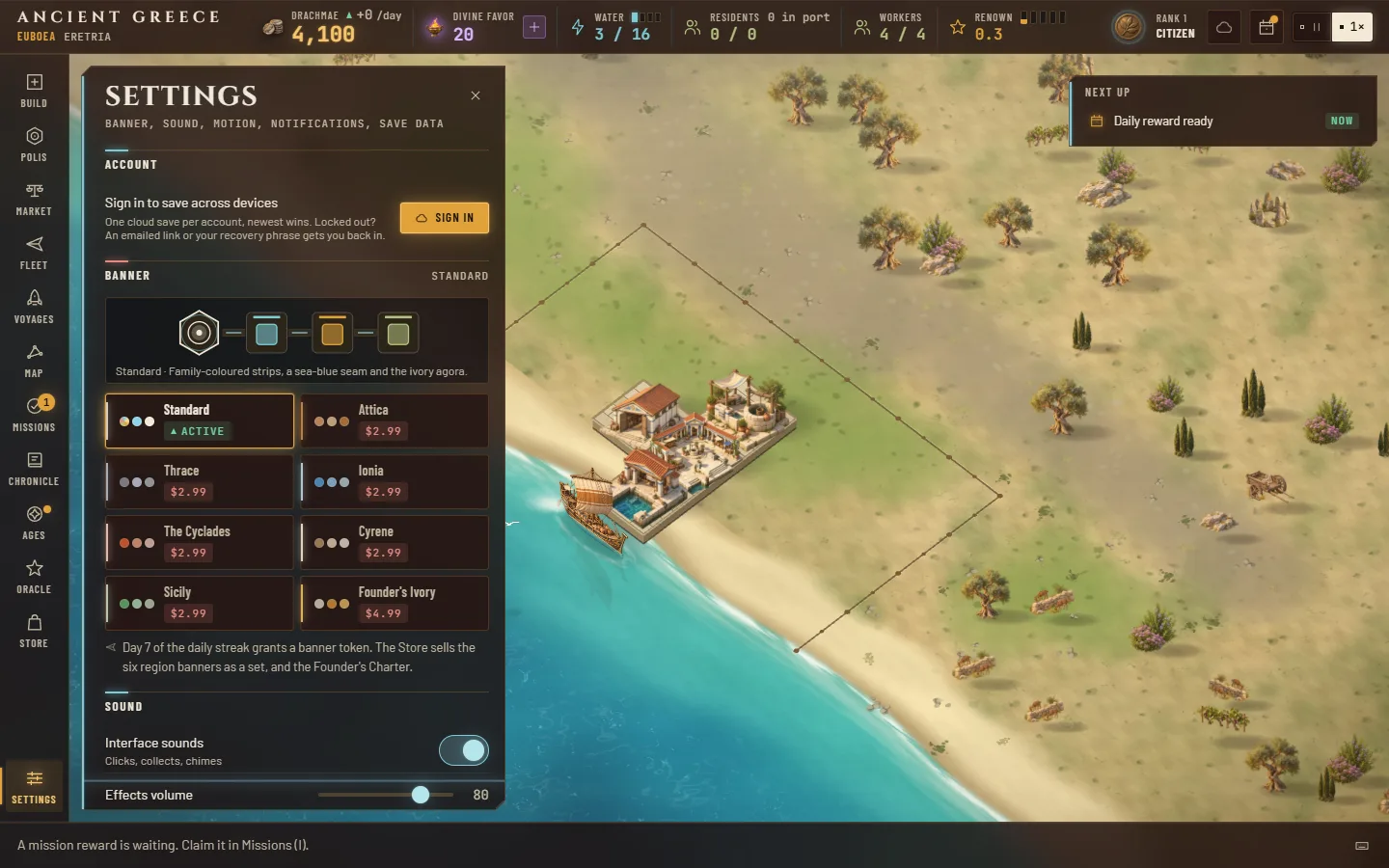
A banner dresses the polis: the lit rim around the platform, the lights along its walkways and gangplanks, the line around each cell and the Agora's glow take its colours, while every building keeps its own picture. Choose one under Settings > Banner: a preview strip shows the active banner and a card for each of the eight. Standard is everyone's. The six region banners (Attica, Thrace, Ionia, the Cyclades, Cyrene and Sicily) come as a set from the Store, or one at a time for a banner token, the day-seven daily reward. Founder's Ivory comes with the Founder's Banner. Your choice is saved with the profile, and nothing about the game changes with it.
A four-hour tier-4 build skips for 30 Favor; at the 140 offering that is about a dollar. That is the whole monetisation: patience is free, haste costs a little, and nobody is locked out.
21Saves, accounts and devicesLocal save · export · cloud
Your profile
Everything you own is one profile: every region's polis, your purse, Divine Favor, rank, missions, achievements, charts, Chronicle, entitlements and settings. It is saved in this browser's local storage every ten seconds while you play and again the moment you switch tabs, hide the window or leave the page. One browser holds one profile. Clearing the browser's site data removes it, so export now and then.
Because timers run on the clock, the save is not a snapshot of a paused world. Open the game a day later and the profile is settled forward: banks filled to their caps, scaffolds finished, voyages back, the active polis replayed through up to two hours of game time.
Export and import
In Settings > Save data, Export save writes your whole profile as text into the box below the buttons; copy it anywhere safe. Import save reads a profile pasted into that box and replaces the one in this browser after a confirm. That is how you move to another computer without an account.
Abandon and reset
Abandon this polis starts a fresh polis in the current region; your rank, Divine Favor, other regions and everything profile-wide stay. Reset profile erases everything, after a double confirm. New profile on the title screen does the same.
Cloud saves
Sign in from the Sign in lozenge on the title band or from Settings > Account:
- You sign in with an email and password (at least ten characters) from the title screen. No third-party sign-in.
- Creating an account hands you a recovery phrase of ten words, shown once. Save it before you dismiss the sheet: it is one of two ways back in without your password. The other is Forgot your password? on the sign-in tab, which emails a link good for 30 minutes to set a new one; either route signs out every other device and issues a fresh phrase.
- One cloud save per account holds the whole profile. The game pushes twenty seconds after any change, at once when you switch region, buy, or claim a mission or achievement, and when you leave the page.
- Opening the game on a second device pulls the newer save. If both the browser and the cloud have moved since the last sync, or you sign in on a browser that already holds a profile, a chooser shows both, with day, level, drachmae, Divine Favor and regions, and you pick which to keep.
- A cloud glyph after the rank ring shows the sync state. Signing out leaves the local profile in place.
Notifications
The Notifications shelf offers a browser notification when a build, upgrade, voyage or ring clearing finishes. Turning Notify me when something finishes on asks the browser for permission; once it is on, a Daily reward reminder (nine in the morning, local time) and Send a test notification appear under it. The chip beside the switch reads On, Off, Connecting, Blocked when the browser refused, Offline when the service cannot be reached, or Unavailable in a browser without push.
Devices
Ancient Greece plays on desktop, tablet and phone, and needs WebGL. The reference layout is 1440×900; at 1180 and below the rail collapses to icons and the panel narrows. Current Chrome, Edge, Firefox and Safari are supported.
22Controls and accessibilityKeys · camera · motion · performance
Everything can be reached from the keyboard, and the keys reference is one press away on ?. Keys do nothing while you are typing in a field or while a dialog is open, apart from Esc.
City
- Space
- Pause or resume
- 1
- Run at 1×
- B
- Build
- S
- Polis
- M
- Market
- F
- Fleet
- E
- Voyages
- G
- World map
- J
- Missions and achievements
- R
- Chronicle
- Esc
- Stop placing, then deselect, then close the panel
- ?
- Keys reference
Camera and world
- Arrows
- Pan
- + · −
- Zoom in and out, 0.55× to 2.6×
- 0
- Fit the polis, never tighter than 1.5×
- F
- Focus the selected building (when a building is selected)
- Wheel
- Zoom toward the cursor
- Drag
- Pan, with inertia
- Click
- Select a building; click empty land to deselect
- Double-click
- Focus a building at 1.6×
- Shift-click
- Collect every ready bank within three cells
- Right-click
- Stop placing, or deselect
- Pinch
- Zoom on a touch screen
Pointer
A four-pixel threshold separates a drag from a click, so a wobbly tap still counts as a tap. The camera stays inside the region grid inflated by six cells, slides aside when a panel would cover the polis, and drifts gently on the title screen only.
Reading the screen
Status is never carried by colour alone: the water readout adds a square or a down-triangle to its hue, trust bars carry a word, chips carry a shape. Body text in the game is 14 pixels or larger, numbers 16, labels 12. Every control is at least 32 pixels tall and shows a two-pixel ring when focused from the keyboard. Nothing flashes faster than three times a second.
Motion
Settings > Motion offers System, Reduced and Full. System follows your operating system's reduced-motion preference. Reduced keeps every tween under 120 milliseconds, drops the panel sweeps, the coin flights (drachmae simply arrive), the camera drift and the bloom pulsing, and skips the boot sequence.
Performance
The world renders in WebGL and measures itself. Effects tier is Auto by default: the game steps down from High to Medium to Low when it falls under 45 frames a second, trimming particle counts, bloom quality, wakes and sparkle in that order. Pin a tier yourself if you prefer, and turn on Show performance readout to see frames per second and the tier in the context bar. Sound is procedural, with separate switches and volumes for interface effects and the harbour ambience; both respect a hidden tab.
Sizes
The screen is laid out for 1440×900 and works from 1180×700. A landscape tablet at 1024×768 gets the rail collapsed to icons; on a phone (portrait, 360 pixels and up) the rail becomes a bottom bar of Build, Polis, Map, Missions and More, the panels open as sheets you can drag down, the status-bar menu holds the daily reward and the other readouts, and the world pans by drag and zooms by pinch.
23GlossaryThe words on the screen
- Divine Favor (Favor)
- The premium currency, always violet. Earned by play, offered in the Store, spent on time: skips, early returns, one early region, a streak repair.
- Bank, coffer
- A building's own store of drachmae, filling by the real minute up to a cap. A coin above the building means it is at least a quarter full; a halo means it is full.
- Chart
- Proof of a voyage to a region. Three charts fully chart it; some regions need one, two or three to unlock.
- Clearing
- The timer on the next ring of plot after you have paid for it. Workers clear it; Divine Favor skips it.
- Civic rank
- Your profile-wide level from 1, Citizen, to 10, Archon of the Aegean, built from XP. Ranks 3, 4 and 5 grant powers.
- Condition
- The strip under the status bar during a drought, a festival, a raid or an outbreak.
- Convoy window
- Forty-eight hours every seven days from your profile's creation, from the second week on, with traffic ×1.5. One mission and one achievement count vessels served inside it.
- Debrief
- Opening a returned voyage's haul. Nothing is rolled until you press it.
- Dispatch
- An event. Most simply happen; two ask you to decide. The simulation waits until you have read it.
- Drachmae (dr)
- The ordinary currency, one purse across every region.
- Efficiency
- Supply over draw when water is short, floored at 30%. It scales fees, rent, spending and quality of life.
- Far region
- The Cyclades, Cyrene, Sicily and the Nile Delta, where builds, upgrades and clearings take 1.5× as long.
- Game day
- Forty-eight seconds of real time at 1×, and only while the game is open. Vessels, trade, residents, prices, renown and dispatches run on game days.
- Gangplank
- The ramp a moored vessel lowers to its quay. Two to five figures walk it: sailors, passengers, traders, a hoplite, porters with a handcart.
- Level, tier
- A polis's rank from L1 Fishing Harbour to L5 Great City, set by building count and renown together. Building tiers 1 to 4 open at levels 1 to 4.
- Live economy
- Everything vessels, visitors and residents pay in the moment, scaled by a factor of 0.06 so that the banks lead.
- Next up
- The strip under the toasts with the three soonest timers.
- Plot, ring
- The cells you may build on, starting 7×5 around the Agora and growing one ring at a time to the whole region grid.
- Quality of life
- The weighted coverage of food, beds, entertainment and health care, times efficiency. It drives spending, residents and renown.
- Quay
- The Stone Quay or the Agora, with the empty cell beside it where a vessel pulls up. A quay with no empty side is blocked.
- Rate, cap
- What a bank earns per real minute and the most it will hold: 180, 240 or 360 minutes of rate by level.
- Region
- One of eight parts of the Greek world, each with its own coast, bias and polis.
- Renown
- Zero to five stars, drifting daily toward a target set by quality of life, variety, residents, temples and how well vessels were served.
- Scaffold
- A building still on its build or upgrade timer: its miniature dimmed under a hatched frame, a ring and a countdown.
- Skip
- Finishing any timer now for Divine Favor: one Favor per eight minutes remaining, rounded up.
- Trust
- A merchant house's opinion of your polis from 0 to 100, starting at 40. It sets how often they come, when they open an office and what they pay to borrow.
- Visitors
- The sailors of moored vessels, counted as in port. They need beds and meals and they spend.
- Water
- What buildings draw and wells, cisterns and aqueducts supply. Run short and everything slows.